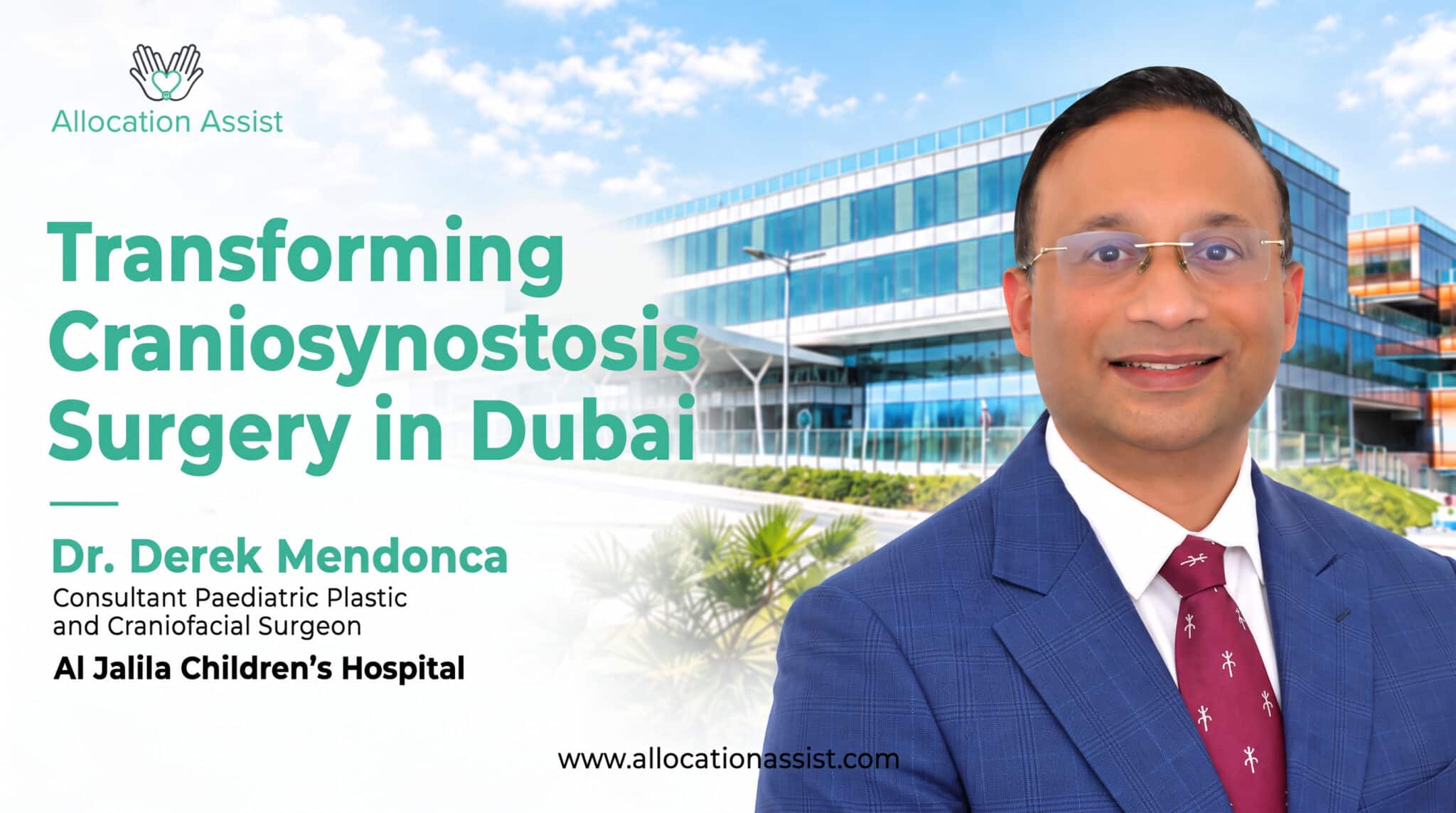
He thought of a baby undergoing major open surgery is difficult for any family. For some babies born with craniosynostosis in Dubai, there is now hope for a less invasive way forward, where selected patients can be treated through smaller incisions, with less time in surgery and an earlier return home. Behind that possibility are years of highly specialized experience brought to Dubai by Dr. Derek Mendonca, who found here the opportunity to work alongside his team to achieve something that had never been done in the UAE before.
Key Takeaways
- Dr. Derek Mendonca is a Consultant Pediatric Plastic and Craniofacial Surgeon at Al Jalila Children’s Hospital.
- He and his team became the first in the UAE to endoscopically correct craniosynostosis with customized helmet therapy.
- He was among the authors of a June 2026 Dubai Health study comparing minimally invasive endoscopic surgery with traditional open surgery for children with craniosynostosis.
- Children treated endoscopically spent less time in surgery, experienced significantly less blood loss and went home sooner, with none requiring ICU care, while still achieving effective cranial correction.
- Allocation Assist Middle East is proud to support Western-trained Doctors building careers in the Gulf.
What Made This a UAE First for Craniosynostosis Care?
Dr. Derek, Consultant Pediatric Plastic and Craniofacial Surgeon at Al Jalila Children’s Hospital, was part of a Dubai Health study comparing minimally invasive endoscopic surgery with traditional open surgery for children with craniosynostosis. The findings showed something significant: children could undergo a far less invasive procedure while still achieving effective cranial correction. But this study was not one moment of innovation. It was the result of years spent building, learning and advancing specialized pediatric care in Dubai.
How Did Years of Experience Become Evidence?
Long before arriving in the UAE, Dr. Derek had built a career around highly specialized pediatric surgery. He trained across the UK and US, including an advanced fellowship in Craniofacial and Pediatric Plastic Surgery at St. Louis Children’s Hospital, and he later worked as a Consultant Pediatric Plastic Surgeon at Cambridge University Foundation Hospital. His expertise includes complex craniofacial reconstruction, cleft lip and palate surgery, facial reanimation and nerve surgery. Alongside more than 30 scientific publications and two patent-pending inventions in cleft and craniofacial surgery, Dr. Derek is the author of the textbook Children’s Plastic Surgery.
Among that experience was a highly specialized approach to craniosynostosis: minimally invasive endoscopic surgery. Dr. Derek and the team at Al Jalila Children’s became the first team in the UAE to endoscopically correct craniosynostosis with customized helmet therapy. For selected babies who would traditionally require major open surgery, there was now another way forward. Through smaller incisions, surgeons could perform a less invasive procedure, and customized helmet therapy would then help guide the baby’s skull as it continued to grow.
But introducing the approach was only the beginning. Over the following years, the team treated more children, built its experience and followed their outcomes. Then, in June 2026, came an important milestone, when Dr. Derek was among the authors of a Dubai Health study comparing children treated endoscopically with those who underwent traditional open surgery.
What Did the Study Reveal for Children and Families?
The results were significant. Children treated endoscopically spent less time in surgery, experienced significantly less blood loss and went home sooner, and none of the children required ICU care. Importantly, less invasive did not mean less effective, because both approaches achieved significant cranial correction, with no major complications or repeat operations reported in the study.
Behind those findings are children spending less time in an operating theatre and fewer days in hospital. For their families, it can mean less time waiting beside a hospital bed and one less worry during an already difficult experience. And for the team behind the study, it marks how far the program has come. What began as a specialized surgical approach in Dubai has developed into years of clinical experience, and now those outcomes are contributing evidence from the UAE to the wider medical community.
What Becomes Possible When Expertise Has Somewhere to Grow?
Dr. Derek did not come to Dubai to begin again. He came with years of experience behind him and found somewhere to keep going. Today, the work at Al Jalila Children’s shows what can happen when experienced specialists have the infrastructure, technology and multidisciplinary teams around them to move their field forward. For Western-trained Doctors considering the Gulf, that matters. Years spent developing your expertise do not have to be left behind when you move, because in the right environment they can become the foundation for what you help build next.
Conclusion
Dr. Derek Mendonca’s story shows what can happen when highly specialized expertise finds the right place to grow. A Consultant Pediatric Plastic and Craniofacial Surgeon at Al Jalila Children’s Hospital, he helped his team become the first in the UAE to endoscopically correct craniosynostosis with customized helmet therapy, and he went on to co-author a June 2026 Dubai Health study showing that children treated endoscopically spent less time in surgery, lost significantly less blood and went home sooner, all while achieving effective cranial correction. What began as a specialized surgical approach has become years of clinical experience and evidence shared with the wider medical community. For accomplished Doctors, it is a reminder that the years spent building your expertise do not have to be left behind, and in the right environment they can become the foundation for what you help build next.
Thinking About a Move to the Gulf?
At Allocation Assist Middle East, we have introduced more than 500 Doctors to over 95 hospitals across the region, helping Western-trained Consultants and Specialists continue their careers in the Gulf. If you are considering the UAE, Saudi Arabia or Qatar, your next move does not have to mean starting again. It could be where everything you have already built takes you somewhere new. Check your eligibility or Call +971 4 273 3477 today and take the next step in your medical career.
Frequently Asked Questions
What is craniosynostosis?
Craniosynostosis is a birth defect in which one or more of the joints between a baby’s skull bones close too early, before the brain has finished growing. Because the skull cannot expand normally, the head can become misshapen, and it is one of the conditions treated with surgery in a baby’s first year.
What is endoscopic craniosynostosis surgery, and how is it different from open surgery?
Endoscopic surgery corrects craniosynostosis through small incisions rather than a large opening in the scalp, so it is less invasive than traditional open surgery. It generally means shorter time in surgery, less blood loss and a quicker return home, and a custom helmet is usually worn afterwards to help guide the skull as it grows.
What did the Dubai Health study on craniosynostosis find?
The June 2026 study compared children treated with minimally invasive endoscopic surgery against those who had traditional open surgery. Children treated endoscopically spent less time in surgery, had significantly less blood loss and went home sooner, with none needing ICU care, while both approaches achieved effective cranial correction with no major complications or repeat operations reported.
What are the signs of craniosynostosis in a baby?
Common signs include a misshapen head, a hard bony ridge that can be felt along a skull suture, a soft spot (fontanelle) that feels different or disappears, and a head that grows more slowly than expected. Parents who notice an unusual head shape should have it assessed by a specialist.
At what age is craniosynostosis usually treated?
Craniosynostosis is often treated within a baby’s first year, and the minimally invasive endoscopic approach works best when babies are still very young, usually in the first few months of life. Timing depends on the type and severity, so early referral to a craniofacial specialist is important.