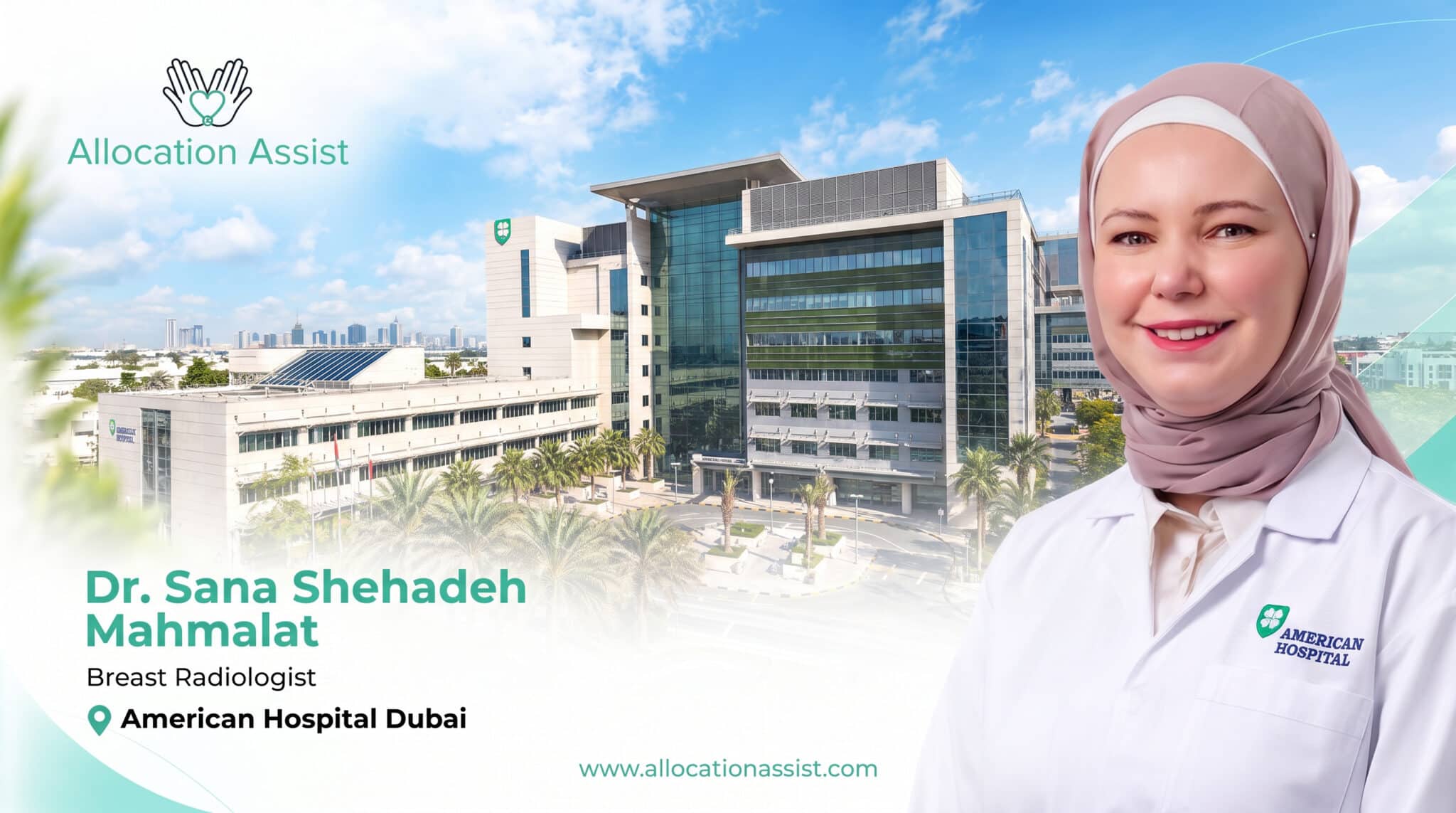
Six months can be enough to know whether a move was the right one. For Dr. Sana Shehadeh, her first months in Dubai have brought both professional momentum and a growing sense of home.
Key Takeaways
- Dr. Sana Shehadeh is a Breast Radiologist at American Hospital Dubai with more than a decade of experience in diagnostic and interventional breast imaging.
- She spent years building that expertise in Spain before relocating to Dubai.
- Her professional focus is on making breast cancer screening more personalized and risk-based, looking at each woman’s individual risk factors to help shape when and how screening should take place.
- Outside the hospital, her family is settling in, with her daughters having started school and a growing sense of stability and comfort.
- Allocation Assist Middle East is proud to have represented Dr. Sana Shehadeh in her relocation to the UAE.
What Have Dr. Sana Shehadeh’s First Months in Dubai Looked Like?
A Breast Radiologist at American Hospital Dubai, Dr. Sana Shehadeh brings more than a decade of experience in diagnostic and interventional breast imaging. She spent years building that expertise in Spain, and now, in Dubai, she has found an environment where everything she worked for is falling into place. It has also given her room to settle, align and focus on what matters most to her professionally.
How Is She Making Breast Cancer Screening More Personal?
What matters most to her professionally is helping make breast cancer screening more personalized and risk-based. For Dr. Sana Shehadeh, that means looking at each woman’s individual risk factors to help shape when and how screening should take place.
How Is Life Taking Shape Outside the Hospital?
Outside the hospital, life is finding its rhythm too. Her daughters have started school, her family is settling into Dubai, and there is a growing sense of stability and comfort. This is one of the most rewarding parts of what Allocation Assist Middle East does, helping Doctors relocate, then seeing what begins to take shape afterwards.
Conclusion
Six months in, Dr. Sana Shehadeh’s move to Dubai has brought both professional momentum and a growing sense of home. A Breast Radiologist at American Hospital Dubai with more than a decade of experience in diagnostic and interventional breast imaging, she has found an environment where everything she worked for is falling into place, with room to focus on making breast cancer screening more personalized and risk-based. Alongside that, her family is settling in and life is finding its rhythm. It is one of the most rewarding parts of what we do: helping Doctors relocate, then seeing what begins to take shape afterwards.
Thinking About a Move to the Gulf?
We are proud to have represented Dr. Sana Shehadeh in her relocation and to see this next chapter of her career unfolding in the UAE. If you’re a Western-trained Doctor thinking about moving to the UAE, Saudi Arabia, or Qatar, your next move could give you new ways to build on your expertise. More than 500 Doctors did not have to figure it out alone. Neither do you. 11+ years of experience. A network of 95+ hospitals. Let us find the right opportunity for you. Send us a message.
Frequently Asked Questions
At what age should women start having mammograms?
Guidance from the US Preventive Services Task Force recommends that women at average risk begin mammograms at age 40. The American Cancer Society suggests women can start annual screening from 40, with yearly mammograms advised from 45, and some bodies such as the American College of Radiology also recommend starting at 40.
How often should a woman have a breast cancer screening?
It depends on age and the guideline followed. The US Preventive Services Task Force recommends screening every two years from age 40 to 74, while the American Cancer Society recommends yearly mammograms from 45 to 54, then every one to two years after 55. A woman’s individual risk may change how often screening is advised.
What is risk-based breast cancer screening?
Risk-based, or personalized, screening sets when and how often a woman is screened according to her individual risk rather than age alone. Factors such as age, family history, genetics, breast density and lifestyle are used to tailor the plan, so higher-risk women may be screened earlier or more often.
What is the difference between a mammogram, breast ultrasound and breast MRI?
A mammogram is an X-ray of the breast and the main tool for routine screening. Ultrasound uses sound waves and is often used to look more closely at a specific area or in women with dense breasts, while MRI uses a magnetic field to produce detailed images and is usually reserved for higher-risk women or further assessment.
Why does breast density matter in screening?
Dense breast tissue can make cancers harder to see on a mammogram, because both dense tissue and tumours appear white. Women with dense breasts may be offered additional imaging, such as ultrasound or MRI, alongside their mammogram to improve detection.