
Saudi Arabia’s healthcare sector is growing under Vision 2030, and government and private hospitals recruit foreign doctors across most specialties. To take a doctor job in Saudi Arabia you need a job offer from a Saudi employer, professional classification and registration with the Saudi Commission for Health Specialties (SCFHS), and a work visa and Iqama sponsored by that employer. You can apply for SCFHS classification from outside the Kingdom, so many doctors start licensing while they interview.
Allocation Assist helps doctors from the UK, Ireland, Europe and elsewhere secure hospital roles in the Kingdom through its medical job consultancy in Saudi Arabia, alongside SCFHS licensing.

1. Healthcare Sector Overview
Saudi Arabia’s Vision 2030 is a strategic framework aimed at diversifying the economy and improving public services, and its Health Sector Transformation Program covers the growth of hospitals, technology and services. The Ministry of Health and private hospital groups are the two main employers of doctors.
The Ministry of Health oversees the public healthcare system, which provides free medical services to Saudi citizens. Private hospitals are also open to both locals and expatriates, offering high-quality care and advanced medical treatments. Some of the leading healthcare institutions include King Faisal Specialist Hospital and Research Centre, King Abdullah Medical City, and the National Guard Health Affairs.
2. High-Demand Medical Specialties in Saudi Arabia
Consultants: Consultant roles are concentrated in Riyadh, Jeddah and Dhahran, in tertiary hospitals and specialised medical centres. Hospital-level detail is in the Riyadh hospitals guide and Jeddah hospitals guide, and background on Saudi Arabia’s healthcare system explains how public and private employers differ.
The government is investing heavily in healthcare, creating numerous opportunities for consultants to contribute to developing the healthcare system. This trend will likely continue, attracting medical professionals to Saudi Arabia, much as getting a medical job in Qatar draws talent across the wider Gulf region.
Specialists: Opportunities abound in specialties like cardiology, pulmonology, neurology, endocrinology, and oncology, where advanced medical expertise is in high demand. Cardiologists are needed to address the rising prevalence of cardiovascular diseases, while oncologists are essential for the treatment of cancer patients. Current openings are posted on our job listings, including roles such as a consultant pediatric interventional cardiologist in Saudi Arabia.
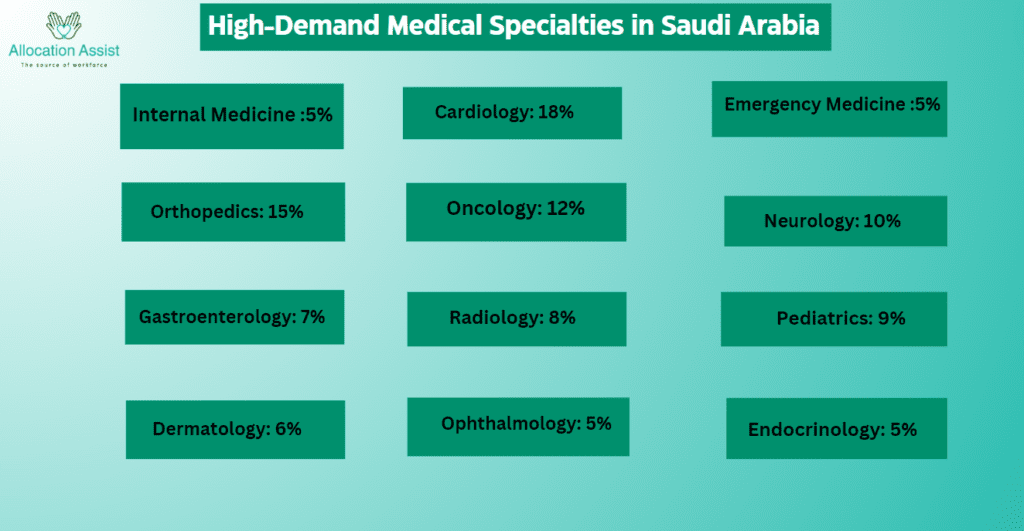
Surgeons: Surgical roles are regularly advertised, including ENT, orthopedic and cardiovascular surgery.
Pediatricians: Pediatric roles are also in steady demand as the country expands child health services.
3. Benefits of Working in Saudi Arabia
Competitive Salaries and Benefits: Doctors in Saudi Arabia usually receive housing or a housing allowance, transport, health insurance and annual flights on top of salary. As a general guide, GPs earn about SAR 15,000 to 30,000 per month, specialists SAR 25,000 to 50,000 and consultants SAR 45,000 to 90,000; the full breakdown is in doctors salary in Saudi Arabia.
Tax-Free Income: Saudi Arabia does not impose income tax on earnings that come only from employment in the Kingdom, for Saudi and non-Saudi employees alike.
Career Advancement: There are multiple opportunities for professional development, including access to international medical conferences and training programs. Many hospitals support continuing medical education, which matters because doctors need 60 CME hours to renew SCFHS registration every 2 years. See CME for doctors working in Saudi Arabia.
4. Work Culture and Environment
Work Culture in Saudi Arabia: Hospital teams are international, and English is the main working language in most large hospitals. If you are choosing a city, see best places to live in Saudi Arabia.
Adapting to the Local Environment: Understanding and respecting local customs and traditions makes the move easier.
Cultural Sensitivity: Being culturally sensitive and aware of local practices enhances professional relationships and patient care. This includes understanding the importance of family in Saudi society and respecting religious practices.
Related Articles:
5 Common Misconceptions about Saudi Arabia
Transformation in Saudi Arabia’s Healthcare Sector
5. How to Find Job Opportunities
Online Job Portals: Websites like Indeed, Jooble, and some other portals list numerous job openings for doctors in Saudi Arabia. These platforms allow you to search for jobs based on your specialty and location preferences.
Medical job consultancies: A consultancy that works directly with hospitals can match your specialty and grade to open roles. Allocation Assist is a medical licensing and job consultancy that supports doctors through the hospital application and SCFHS licensing process.
Before applying, check how SCFHS is likely to grade you, since hospitals hire against the SCFHS title. Eligibility by country of training is covered in SCFHS eligibility requirements by country of training.
Networking: Attending medical conferences and joining professional associations can provide valuable networking opportunities. Conferences such as the Saudi Health Exhibition and the Arab Health Exhibition are excellent platforms to connect with potential employers and colleagues.
Direct Applications: Applying directly to hospitals and healthcare institutions can also be effective. Many hospitals have dedicated career pages on their websites where you can submit your application.
6. Visa and Work Permit Requirements
Visa Application Process: Your employer sponsors your work visa, which needs your signed contract, attested documents and a medical examination. After arrival the employer issues your Iqama, the residence permit you need for SCFHS registration.
Licensing Requirements: Your qualifications are verified by an SCFHS-approved company such as DataFlow, and SCFHS classifies you before registration. Classification takes 7 working days for a direct decision, 30 working days for the written exam route and 35 working days for practical evaluation; registration takes 5 working days and is valid for 2 years.
Relocation Tips: Housing, schooling and the Iqama process are covered in our relocation guide for doctors moving to Saudi Arabia.
7. Doctors Working in Saudi Arabia
Many doctors from the UK and Europe have successfully built rewarding careers in Saudi Arabia. Dr. Abdul Aziz, an internal medicine/cardiology doctor from Sweden, shares his experience: “Moving to Saudi Arabia was one of the best decisions I made for my career. The facilities are top-notch, and the work environment is very supportive. I have also had the opportunity to travel and experience the rich culture of the region.”
Dr. Renata Valdes, an internal medicine specialist at King Abdulaziz Medical City in Riyadh (Ministry of National Guard Health Affairs), said in her interview with Allocation Assist: “Working at MNGHA gives me great opportunities to grow in many areas.”
Conclusion
Saudi Arabia offers a promising career path for Western-trained doctors from the United Kingdom and Europe. With its high demand for medical professionals, competitive salaries, and enriching cultural experience, it is an excellent choice for all healthcare professionals looking to advance their careers. If you are ready to pursue new opportunities, consider moving to Saudi Arabia with the assistance of Allocation Assist.
You can easily process your application and find the perfect job that matches your skills and aspirations with the expertise and support of Allocation Assist. Don’t miss the chance to enhance your career and experience in Saudi Arabia. Start your journey today!
Looking for a Medical Role in Saudi Arabia?
Allocation Assist works with hospital groups in Riyadh, Jeddah and other Saudi cities and helps doctors secure roles that match their SCFHS grade, alongside SCFHS licensing in Saudi Arabia. Typical fees and timings are set out in SCFHS license cost and timeline. The team can be reached through the contact page.
Frequently Asked Questions
Can foreign doctors work in Saudi Arabia?
Yes. Foreign doctors work in Saudi Arabia after SCFHS professional classification and registration, with a work visa and Iqama sponsored by their employer. Non-Saudi doctors need at least 1 year of experience for classification, and classification can be applied for from outside the Kingdom through Mumaris Plus.
Can an American doctor get a job in Saudi Arabia?
Yes. US-trained doctors follow the same SCFHS route as other foreign doctors. How SCFHS grades a US board certification is covered in SCFHS eligibility requirements by country of training.
How do I apply for a doctor job in Saudi Arabia?
Apply to hospitals directly, through job portals, or through a medical job consultancy that works with Saudi hospitals. In parallel, start DataFlow verification and SCFHS classification, since the employer needs your classification before it can sponsor your work visa.
How much does a doctor get paid in Saudi Arabia?
As a general guide, GPs earn about SAR 15,000 to 30,000 per month, specialists SAR 25,000 to 50,000 and consultants SAR 45,000 to 90,000, with housing and other allowances usually on top. Employment income is not taxed.
Which doctors are in demand in Saudi Arabia?
Hospitals regularly recruit consultants and specialists in cardiology, oncology, neurology, pulmonology, endocrinology, orthopedics, ENT, cardiovascular surgery and pediatrics, mostly in Riyadh, Jeddah and Dhahran.
Which Arab country is best for doctors?
It depends on your specialty, qualifications and family plans. Saudi Arabia has one regulator (SCFHS) for the whole country, the UAE has three authorities (DHA, DOH and MOHAP) that share one set of qualification rules, and Qatar licenses doctors through the Department of Healthcare Professions.
Read more articles: