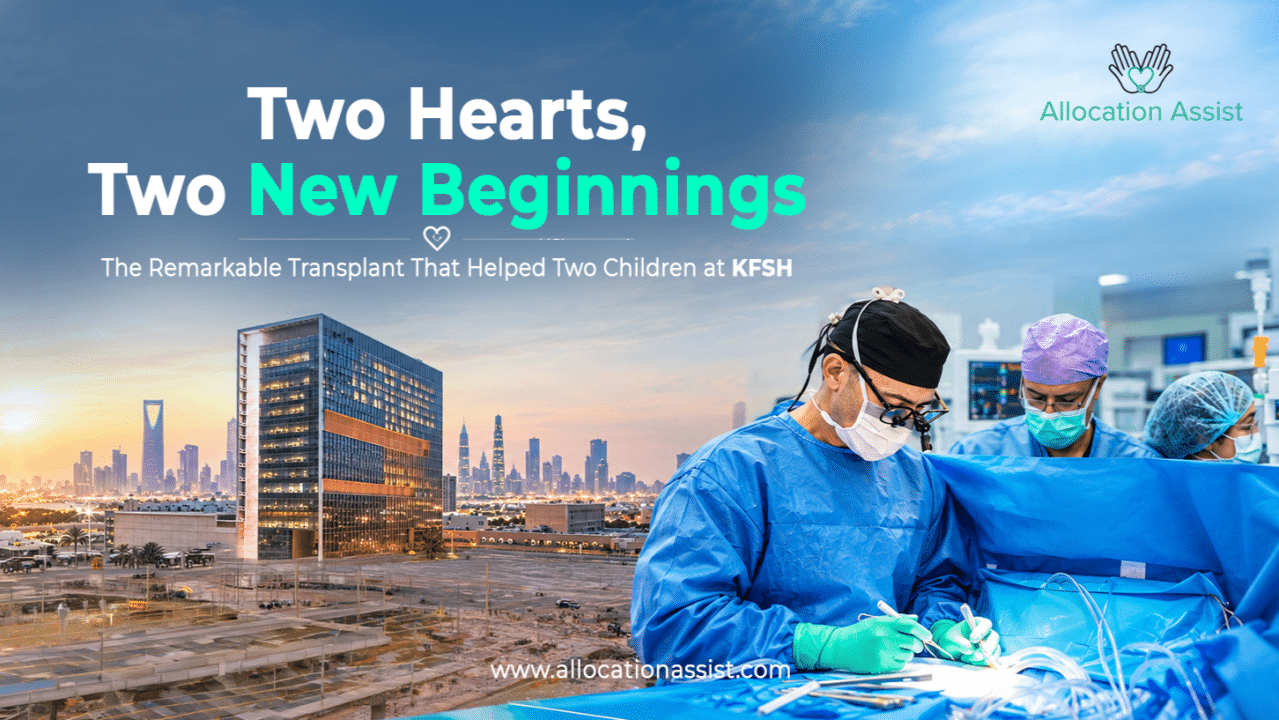
For six weeks, a 12-year-old boy’s world had narrowed to a hospital room and the steady rhythm of monitors. His heart was failing, and when a donor heart finally became available, the story took an extraordinary turn. The heart that could give him a new beginning would not be the only one to change a life. Because the heart he was leaving behind still had something to give. It would go on to help another child. What followed was a rare pediatric domino heart transplant, where one gift of life travelled further than anyone could have imagined.
Key Takeaways
- King Faisal Specialist Hospital & Research Centre (KFSH) describes the procedure as the first pediatric domino heart transplant of its kind in the Middle East and Europe.
- The first child was living with dilated cardiomyopathy and end-stage heart failure.
- The second child was nine years old and living with severe aortic stenosis and regurgitation.
- Unlike a conventional prosthetic valve, the valve he received is living tissue.
- Specialists across transplantation, congenital cardiac surgery, pediatric cardiology, imaging, anesthesia and critical care worked as one team.
What Happened With the Heart He Was Waiting For?
As surgeons began to prepare for the transplant, they recognized something important: although his heart could no longer keep him alive, his pulmonary valve and root remained viable.
The first child was living with dilated cardiomyopathy and end-stage heart failure, receiving continuous medication to keep his failing heart functioning during his long wait.
And, in a remarkable coincidence, another child at the same hospital needed exactly that. The second child was nine years old and living with severe aortic stenosis and regurgitation. After two previous procedures to repair his affected valve, he now needed a more complex operation known as the Ross procedure.
During a Ross procedure, the patient’s own healthy pulmonary valve is moved to replace the damaged aortic valve. But moving one valve leaves another position that needs to be filled.
This time, the answer came from the first child’s explanted heart, turning what one child could no longer use into a new source of hope for another.
| Detail | First child | Second child |
|---|---|---|
| Age | 12 | Nine |
| Living with | Dilated cardiomyopathy and end-stage heart failure | Severe aortic stenosis and regurgitation |
| Before surgery | Continuous medication during his long wait | Two previous procedures to repair his affected valve |
| What he received | A donor heart | The pulmonary valve and root from the first child’s explanted heart, through the Ross procedure |
How Is This a Gift That Can Grow With Him?
Unlike a conventional prosthetic valve, the valve he received is living tissue. It has the potential to grow as he grows, possibly reducing the need for repeated valve replacement surgery later in childhood.
For the nine-year-old, the significance of that gift goes even further. Making this possible required extraordinary foresight and coordination, with specialists across transplantation, congenital cardiac surgery, pediatric cardiology, imaging, anesthesia and critical care working as one team.
King Faisal Specialist Hospital & Research Centre (KFSH) describes the procedure as the first pediatric domino heart transplant of its kind in the Middle East and Europe.
Dr. Hani Alsergani, Executive Director of the Heart Centre of Excellence at KFSH, described the significance of what they had achieved:
“This is one of the rarest forms of partial heart transplantation in children and places KFSH among a select group of centres worldwide capable of performing it, building on the hospital’s expertise in heart transplantation and complex congenital cardiac surgery.”
How Does Expertise Create New Possibilities?
It is experienced doctors recognizing possibilities others might miss, multidisciplinary teams with the expertise to act on them, and healthcare systems capable of making that level of care possible.
Milestones like this show what healthcare progress in the Middle East looks like beyond new hospitals, technology and investment.
At KFSH, those things came together around two children whose stories might otherwise never have crossed. One heart was donated. What it gave did not stop with one child.
For Western-trained doctors considering the Middle East, stories like this offer a glimpse of what is being built across the region: healthcare environments where specialist expertise can contribute to complex care, collaboration and new possibilities for patients.
Allocation Assist Middle East has represented more than 500 doctors in taking the next step in their careers across the Gulf, working with more than 95 hospitals across the region. Western-trained doctors considering a move to Saudi Arabia, the UAE or Qatar can send Allocation Assist a message to explore where their experience could take them next.
How Allocation Assist Supports Doctors Relocating to the Gulf
As a medical job consultancy in Dubai, our team has supported Western-trained doctors across the UAE, Saudi Arabia, and Qatar for over 11 years, and maintains relationships with 95+ leading institutions.
Key Areas of Support
- Hospital matching, finding the right environment for your specialty, seniority, and personality.
- Licensing and regulatory navigation, including DHA, DOH, MOHAP, and SCFHS credentialing.
- Interview and salary negotiation support, so you walk into the conversation prepared.
- Relocation and family logistics, coordinating the practical side of the move for the whole family.
- Ongoing support after you arrive, including networking events and a peer community of doctors who have made the same move.
Frequently Asked Questions
Where was the pediatric domino heart transplant performed?
It was performed at King Faisal Specialist Hospital & Research Centre (KFSH). KFSH describes the procedure as the first pediatric domino heart transplant of its kind in the Middle East and Europe, involving two children at the same hospital.
How old were the two children?
The first child was a 12-year-old boy who had spent six weeks in a hospital room waiting for a donor heart. The second child was nine years old and needed a more complex operation after two previous procedures on his valve.
What condition did the first child have?
He was living with dilated cardiomyopathy and end-stage heart failure, and received continuous medication during his long wait. Although his own heart could no longer keep him alive, surgeons recognized that his pulmonary valve and root remained viable.
Why did the second child need a Ross procedure?
He was living with severe aortic stenosis and regurgitation. After two previous procedures to repair his affected valve, he needed a more complex operation. The Ross procedure left a position to be filled, and the answer came from the first child’s explanted heart.
What is a Ross procedure?
In a Ross procedure, the patient’s own healthy pulmonary valve is moved to replace the damaged aortic valve. Moving one valve leaves another position that needs to be filled. In this case, it was filled with the pulmonary valve and root from the first child’s explanted heart.
Who is Dr. Hani Alsergani?
Dr. Hani Alsergani is Executive Director of the Heart Centre of Excellence at KFSH. He described the procedure as one of the rarest forms of partial heart transplantation in children, placing KFSH among a select group of centres worldwide capable of performing it.