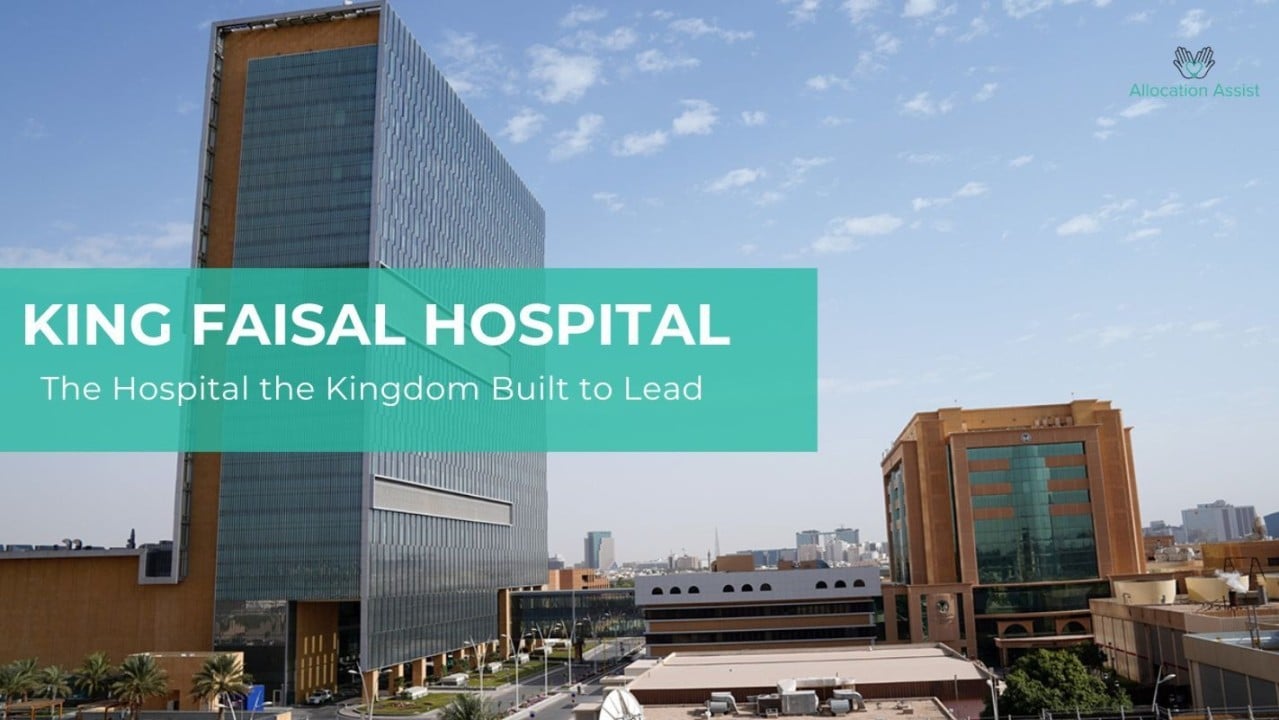
In 1970, King Faisal donated 450,000 square metres of Riyadh land and laid the foundation stone himself. The hospital opened five years later, in 1975, and within three years had built Saudi Arabia’s first cardiac surgical centre. That speed became the pattern the institution would keep. King Faisal Specialist Hospital and Research Centre, or KFSHRC, is now a three-site national network across Riyadh, Jeddah, and Madinah, the hospital the Kingdom turns to when the stakes are highest. What follows is how the network is built, its centres of excellence, its research, and what the work looks like for a Western-trained consultant.
What Kind of Hospital Is KFSHRC?
KFSHRC operates as a tertiary and quaternary referral centre, woven directly into the Kingdom’s national health system. Across Riyadh, Jeddah, and Madinah, it now runs more than 2,400 beds, over 65 specialties, and treats more than four million patients a year. In 2023 alone, that meant over 40,000 admissions and close to 1.9 million outpatient visits across the network. Referrals arrive through three channels: the hospital’s own Ehalat platform, the Ministry of Health’s national Ehalati programme, and regional health cooperation offices across the Kingdom. More than 107 nationalities pass through its doors.
| KFSHRC at a glance | Detail |
|---|---|
| Network | Three campuses: Riyadh, Jeddah, Madinah |
| Beds | 2,400+ |
| Specialties | 65+ |
| Patients a year | 4 million+ |
| 2023 admissions | 40,000+ |
| 2023 outpatient visits | Close to 1.9 million |
| Nationalities treated | 107+ |
How Did KFSHRC Grow, and What Changed in 2021?
The Riyadh hospital opened in 1975, inaugurated by King Khalid. A cardiac surgical centre followed in 1978, the first of its kind in the country. An organ transplant programme began in 1981 with the institution’s first kidney transplant, and a heart transplant followed in 1989. By 1984, the hospital was already running stem cell transplants, the first centre to do so anywhere in the World Health Organization’s Eastern Mediterranean region. A Jeddah campus opened in 2000, and a royal order merged it into the same general organisation as Riyadh in 2008. Madinah, the newest campus, followed in 2021.
That same year, KFSHRC became an independent sui generis non-profit foundation, aligned with Saudi Vision 2030, state-backed but no longer run as a standard Ministry of Health hospital. The change was financial. KFSHRC remains state-funded, but the foundation model lets it earn and reinvest its own revenue, from international patients to diagnostic services sold to other hospitals. For a Western-trained consultant, the closest comparison is a foundation trust, publicly accountable but governed with more autonomy than a government department.
What Does Each of the Three Campuses Do?
Riyadh is the flagship and the deepest of the three. Organ transplant, oncology, genomics, cardiac care, and neuroscience are all anchored there, alongside the bulk of the research infrastructure. Jeddah extends that tertiary reach into the western region, and Madinah, the newest, was built around oncology, ophthalmology, and women’s health with a smart-hospital design from day one.
| Campus | Beds | Focus and distinction |
|---|---|---|
| Riyadh | ~1,500 | Flagship: organ transplant, oncology, genomics, cardiac care, neuroscience, and most research infrastructure |
| Jeddah | 537 | Oncology, transplant-linked care, cardiac care, paediatrics; first Magnet-designated hospital in Saudi Arabia and the GCC, the only one in the GCC to hold it three times |
| Madinah | 400 | Oncology, ophthalmology, women’s health; smart-hospital design from day one |
What Are KFSHRC’s Centres of Excellence?
The Organ Transplant Centre of Excellence has run since 1981, when the hospital performed Saudi Arabia’s first kidney transplant. In September 2023, the team performed the world’s first fully robotic liver transplant from a living donor, and a year later extended the technique to left-lobe grafts, opening the procedure to patients whose anatomy had previously ruled it out. The cardiac programme, which opened the country’s first cardiac surgical centre in 1978 and performed its first heart transplant in 1989, went on to perform the world’s first fully robotic heart transplant in September 2024, on a sixteen-year-old who had asked the team not to open his chest. Four months later came the world’s first robotic HeartMate 3 implant, whose recipient spent four days in intensive care against an average of twenty-six.
The Cancer Centre of Excellence treats close to a quarter of all cancer cases diagnosed in Saudi Arabia each year and runs its own CAR T-cell therapy programme for blood cancers, one of a small number of centres in the region able to manufacture the treatment rather than simply administer it. Genomic medicine, established as its own centre in 2011, is the Kingdom’s primary referral point for genetic disease, running eleven dedicated clinics and, by 2023, more than seven thousand whole genome sequencing tests. Neuroscience rounds out the platform, anchored by the Middle East’s first Smart Neuroscience Ward, opened in September 2025, with sixteen single-patient, electromagnetically shielded epilepsy monitoring rooms.
What Research and Innovation Runs at KFSHRC?
By the end of 2024, the hospital accounted for 52 percent of all active clinical studies running anywhere in Saudi Arabia. In 2023 alone, its research centre logged 1,151 indexed publications and 60 active interventional clinical trials, and several of its scientists rank among Stanford’s most-cited researchers, with work appearing in Nature Communications, the New England Journal of Medicine, and Lancet Haematology. Robotic procedures rose from 1,195 in 2023 to 1,370 in 2024. In late 2025, the hospital opened Saudi Arabia’s first gene and cell therapy manufacturing facility on its Riyadh campus, built to produce the country’s own CAR T-cell and stem-cell therapies rather than import them.
What Accreditations and Training Does KFSHRC Hold?
JCI accreditation has covered the network since 2000, renewed for a further three years as recently as 2024. CBAHI accreditation covers clinical and governance standards within the Saudi system, held hospital-wide in Riyadh and achieved by Madinah within three years of opening. KFSHRC also holds Global Healthcare Accreditation at a 95 percent score, and patient satisfaction across the network sits at 4.6 out of 5, from more than 83,000 reviews in 2024 alone.
On training, Academic and Training Affairs has run for more than thirty years and now oversees 30 residency programmes and 71 sub-specialty fellowships, certified through the Saudi Commission for Health Specialties. Jeddah runs a separately accredited obstetrics and gynaecology track, and Madinah, the newest campus, has moved fastest, with fourteen training accreditations achieved within a few years of opening.
What Is It Like to Work at KFSHRC as a Consultant?
The network’s physician body runs to 1,750 doctors, inside a workforce of more than 16,000 drawn from over 63 nationalities. A hospital performing the world’s first robotic heart transplant and running 52 percent of the country’s clinical trials is not an institution moving slowly. Compensation follows the structure familiar across the Gulf, a tax-free salary, an end-of-service gratuity, and a housing allowance, with the specific terms shaped by specialty and seniority.
Timing is part of the picture. KFSHRC became an independent foundation only in 2021, after fifty years as a single-track government hospital, so a consultant arriving now joins an institution with five decades of depth and only a few years of practising what its new independence allows it to become.
How Allocation Assist Supports Doctors Relocating to the Gulf
As a medical recruitment and healthcare jobs consultancy in Dubai, our team has been placing Western-trained doctors in top-tier hospitals across the UAE, Saudi Arabia, and Qatar for over 11 years. We work exclusively with consultant-level physicians and maintain relationships with 95+ leading institutions.
Key Areas of Support
- Hospital matching, finding the right environment for your specialty, seniority, and personality.
- Licensing and regulatory navigation, including DHA, DOH, MOHAP, and SCFHS credentialing.
- Interview and salary negotiation support, so you walk into the conversation prepared.
- Relocation and family logistics, coordinating the practical side of the move for the whole family.
- Ongoing support after you arrive, including networking events and a peer community of doctors who have made the same move.
Frequently Asked Questions
What is King Faisal Specialist Hospital and Research Centre?
KFSHRC is a three-campus national network across Riyadh, Jeddah, and Madinah, and the hospital in Saudi Arabia that turns to for its most complex cases. It runs more than 2,400 beds and over 65 specialties and treats more than four million patients a year.
Where are KFSHRC’s campuses?
Riyadh is the flagship with roughly 1,500 beds, Jeddah carries 537 beds, and Madinah, the newest, has 400 beds. Riyadh anchors organ transplant, oncology, genomics, cardiac care, and neuroscience.
What world firsts has KFSHRC performed?
KFSHRC performed the world’s first fully robotic liver transplant from a living donor in September 2023, the world’s first fully robotic heart transplant in September 2024, and the world’s first robotic HeartMate 3 implant four months after that.
Is KFSHRC accredited?
Yes. JCI accreditation has covered the network since 2000 and was renewed in 2024. It also holds CBAHI accreditation within the Saudi system and Global Healthcare Accreditation at a 95 percent score, with patient satisfaction at 4.6 out of 5 across more than 83,000 reviews in 2024.
Does KFSHRC support research and training?
Yes. By the end of 2024, it accounted for 52 percent of all active clinical studies in Saudi Arabia, and it opened the country’s first gene and cell therapy manufacturing facility in late 2025. Training runs to 30 residency programmes and 71 sub-specialty fellowships certified through the Saudi Commission for Health Specialties.
What is the compensation structure at KFSHRC?
Compensation follows the Gulf structure of a tax-free salary, an end-of-service gratuity, and a housing allowance, with the specific terms shaped by specialty and seniority.
Does KFSHRC treat international patients?
Yes. Patients arrive from at least seventeen countries, and the hospital runs an advanced telemedicine centre connecting with 32 hospitals at once for tele-ICU consultations, second opinions, and tele-education. It also pairs the standard international pathway with a dedicated spiritual and wellness programme.