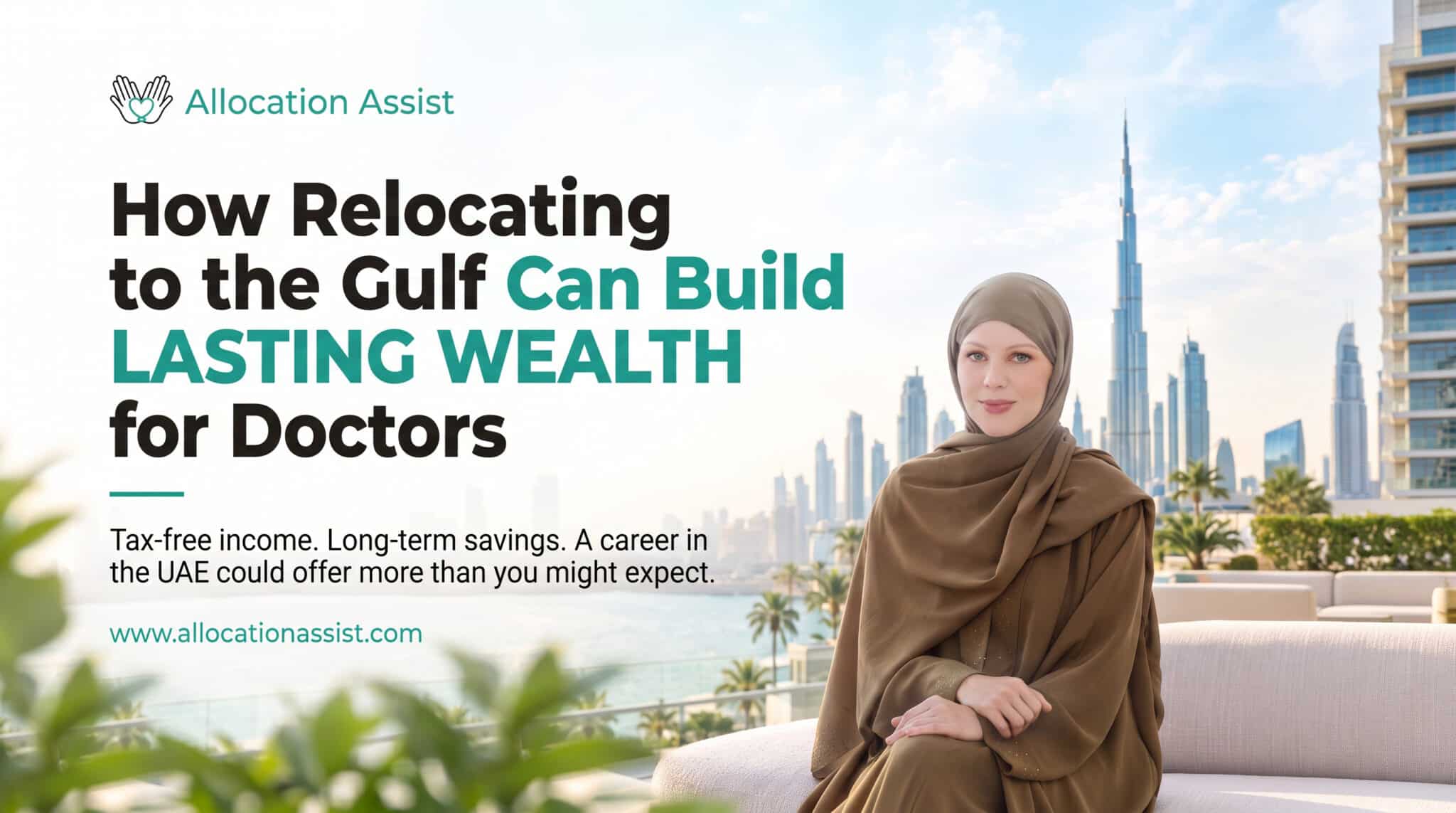
You have spent years building your medical career, so it is worth asking what your next move could mean for your financial future. For Western-trained doctors, a move to the Gulf can offer competitive salaries, tax-free employment income and the room to build long-term savings. But building wealth in the Gulf is about more than a bigger number on the contract. It starts with understanding how your salary is structured and making informed decisions about the years ahead.
Is Relocating to the Gulf Really About the Salary?
A higher salary is usually the headline, but it is rarely the whole story. A decision to relocate is also about the opportunities a role opens up, the offer behind it, and what the move makes possible for a doctor and their family. Allocation Assist helps Western-trained doctors understand those opportunities, evaluate offers and plan their relocation with confidence, so the choice rests on more than the pay figure alone.
What Does 0% Income Tax Mean for Your Take-Home Pay?
The UAE charges no personal income tax on employment salaries, so doctors keep their full pay rather than losing a share to deductions. A monthly salary of AED 90,000, for example, adds up to around AED 1.08 million over a year with nothing taken in UAE income tax. For doctors coming from higher-tax countries, that difference can free up a meaningful amount to save or invest each year.
Why Does Your Salary Structure Matter as Much as the Headline Figure?
Not every hospital offers the same salary structure or benefits. Some packages link part of the income to patient volume or revenue, while others add allowances such as housing or schooling, so two offers that look similar on paper can be worth very different amounts. Before signing, it is worth asking a few direct questions.
- What portion of the income is guaranteed?
- How are any incentives calculated?
- Which allowances are included?
The detail behind the offer can matter as much as the figure at the top of it.
How Can Consistent Saving Build Long-Term Wealth?
Tax-free income only becomes wealth when some of it is set aside. As an illustration, a doctor who saves AED 30,000 a month would accumulate around AED 360,000 in a year and about AED 1.08 million over three years, before any investment returns are added. These figures are illustrative rather than a forecast or guaranteed outcome, but they show how steady saving can compound. Over time, consistent savings can become the foundation of greater financial freedom.
Conclusion
A career in the Gulf can offer competitive pay, tax-free employment income and the space to save and invest, more than many doctors expect. The doctors who turn that into lasting wealth tend to be the ones who look beyond the salary alone, know how their package is structured, and save with intent. For a Western-trained doctor weighing the UAE, Saudi Arabia or Qatar, the financial case is strong, provided the decision is made with the full picture in view.
Planning the Financial Side of Your Move?
Knowing what you will actually take home, and keep, is a sensible first step before you commit. As a medical relocation and licensing consultancy for the Gulf, Allocation Assist helps Western-trained doctors evaluate offers, compare salary packages and plan their move, from medical licensing to relocation, backed by 11 years of experience, 95+ hospitals and more than 500 doctors introduced. You can gauge your likely earnings with the Doctor Grade and Salary Estimator, or book a free consultation to talk through your options.
Key Areas of Support
- Hospital matching: finding a role that fits your specialty, seniority and goals.
- Licensing and regulatory navigation: guiding your DHA, DOH, MOHAP or SCFHS application from eligibility to approval.
- Interview and salary negotiation support: so you weigh and discuss an offer from an informed position.
- Relocation and family logistics: coordinating visas, housing and schooling for the whole family.
- Ongoing support after you arrive: including a community of doctors who have made the same move.
Frequently Asked Questions
Is income really tax-free for doctors in the UAE?
The UAE charges no personal income tax on employment salaries, so doctors keep their full pay. Whether you owe tax at home depends on your own tax residency and citizenship, so it is worth checking your position before you move.
How much can a doctor realistically save in the Gulf?
It depends on salary, family costs and lifestyle. As an illustration, setting aside AED 30,000 a month would total roughly AED 360,000 in a year and about AED 1.08 million over three years, before investment returns. These numbers are illustrative rather than a guaranteed outcome.
What should a doctor check in a Gulf salary package?
Look beyond the total at what income is guaranteed, how any incentives are calculated, and which allowances, such as housing or schooling, are included. The structure of the package can matter as much as the figure on paper.
Does a higher salary automatically mean more wealth?
Not on its own. The outcome depends on the salary structure, the cost of living and consistent saving, so two doctors earning the same amount can end up in very different financial positions after a few years.
What allowances are common in a UAE doctor’s package?
Beyond base salary, packages often include housing, schooling and flight allowances, and some add incentives linked to patient volume or revenue. These extras can lift take-home pay well above the headline figure, so they are worth weighing carefully when comparing offers.