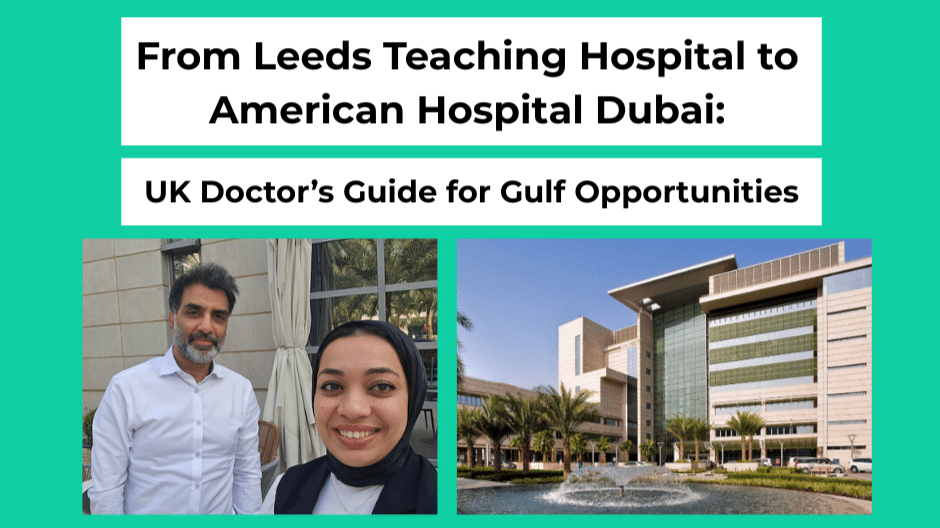
Dr. Usaama Sheikh is a Critical Care Consultant from the UK with dual certification in Intensive Care Medicine and Anaesthesia. He possesses advanced training and expertise in medical and surgical critical care, major trauma and burns. Previously a Consultant at Leeds Teaching Hospitals NHS Trust, he relocated to Sheikh Shakhbout Medical City (SSMC) in Abu Dhabi in February 2024. His journey highlights how professional ambition, family well-being, and a commitment to delivering the best patient care can align when making the move to the UAE.
Key Takeaways
- Dr. Usaama Sheikh completed dual specialist training in Anaesthesia and Intensive Care Medicine at Leeds, gaining advanced airway skills and ventilator expertise.
- NHS resource constraints and a desire to provide optimal patient care motivated his relocation to the UAE.
- He found Allocation Assist on LinkedIn and contacted Emilie and her team, who handled his medical licensing and connected him to large tertiary hospitals.
- He chose SSMC in Abu Dhabi for its state-of-the-art facilities, varied case mix, and Abu Dhabi’s family-friendly pace of life for his three young children.
- The entire relocation process, from first thinking about the move to starting his new job, took less than a year.
- SSMC plans to launch the first Critical Care fellowship in Abu Dhabi from September 2024.
Choosing Critical Care as a Specialty
Dr. Usaama Sheikh grew up in Sheffield and went to medical school at the University of Leeds. After graduation, he wanted to stay in the Leeds area for his specialist training. In the UK, all medical graduates enter a two-year foundation training programme in which they gain experience in a range of medical and surgical specialties. This provides a broad-based understanding of different specialties and a great opportunity to discover which specialty they are best suited to.
He completed dual specialist training, first in Anaesthesia and then Critical Care. Critical Care appealed to him as a specialty because it gives a good mix of book knowledge and practical hands-on treatment. It is a very rewarding specialty where you are able to make a difference for very sick patients. He likes to spend more time with smaller groups of patients, getting to know them and their families. There is an emphasis on good communication and teamwork with many other specialties, which suits his personality.
Of course, the demands of working in an acute specialty require a commitment to regular out-of-hours work, including weekends and public holidays. However, as Dr. Sheikh has noted, the rewards outweigh the demands when you see patients get better and are able to help them and their families through difficult and stressful times.
Dual Training in Anaesthesia and Intensive Care
In the UK in particular, Intensive Care, also known as Critical Care, started as a subspecialty of anaesthesia. While doctors with specialist training in Anaesthesia do work in Intensive Care, Critical Care has developed into a specialty in its own right. The COVID-19 pandemic led to an increased recognition of the need for Critical Care consultants and an increase in training posts.
Doctors specialising in Critical Care may also come from different specialist backgrounds, such as Acute Medicine, Respiratory, Renal, or Emergency Medicine. Having dual training in Anaesthesia and Critical Care has given Dr. Sheikh advanced airway skills, expertise in the use of ventilators, and other procedures. However, in the ICU, consultants with different backgrounds and training work as a team, utilising their wide-ranging knowledge and skills from different specialties. This is essential for delivering the best patient outcomes.
Why Relocate to the United Arab Emirates
Dr. Sheikh had visited the UAE many times before, for holidays or layovers when travelling. His parents also worked in Dubai over 10 years ago, for 3 or 4 years, and he visited them during that time. He loved the culture, lifestyle, and weather in the UAE, so it was always going to be on his list when he started to consider relocating.
He has a great appreciation for the National Health Service in the UK, and utmost respect for his colleagues and all the other staff who work extremely hard in the NHS. However, due to capacity issues, resources have become more thinly spread and he found that it was increasingly becoming more difficult to provide the level of care that he wanted for his patients. So, he started to think about making a move.
In Arabian Gulf countries, such as the UAE, specialist training and qualifications from the UK are recognised and highly valued, which makes the medical licensing and transition process easier than for some other parts of the world. While searching on LinkedIn, he stumbled across Allocation Assist’s profile, where he found a lot of helpful information about the health sector in the UAE and information on lifestyle and relocation considerations for doctors. He contacted Emilie and her team at Allocation Assist, who helped him with his medical licensing and started connecting him to large tertiary hospitals in the UAE.
Choosing Abu Dhabi and Sheikh Shakhbout Medical City
SSMC is a very large tertiary hospital, with state-of-the-art facilities and pretty much every specialty available. It is also a referral centre for trauma, burns, medical oncology, and haematology, amongst other specialties. This means that SSMC receives an interesting and varied case mix. They see a wide range of different conditions and patients undergoing complex surgical procedures. As an Intensive Care physician, it is important to keep up skills, and this requires being part of a large organisation that can provide the full range of treatment.
Prior to interviewing for his current post, there was another consultant job advertised in one of the top hospitals in Dubai. It would also have been a great fit for his training and skills, but ultimately he decided on Abu Dhabi. Both are great places to live, but Dubai is a bit busier with a faster pace of life. When he was considering what to do, he read a blog on Allocation Assist’s page comparing the lifestyle between different emirates in the UAE, and this confirmed that Abu Dhabi would be the best place for his family, with three young children, as it is very family-friendly and the pace of life is a bit slower.
The Relocation Experience
The entire process, from first thinking about relocating to the UAE to starting his new job in Abu Dhabi, took less than a year. Thanks to the licensing team at Allocation Assist, the process of obtaining his licence to work in the UAE went very smoothly, he had to do nothing but supply all his documents. Allocation Assist also provided helpful information on international schools and recommended areas to live in Abu Dhabi, which really helped.
It was a big move for himself and his family, so he was a bit apprehensive, but any concerns he may have had soon melted away after they arrived. They received an incredibly warm welcome. A member of staff from the hospital’s HR team was waiting for them at the airport with two minivans, as he had told them they were coming with a lot of luggage.
Settling In
The hospital initially put the family up in a 3-bed hotel apartment for around 2 months, so that they had time to complete the paperwork for their residency visas and decide on the right school and area to live. SSMC has a government services help desk inside the hospital, so Dr. Sheikh was able to get all the documents they needed, such as Emirates ID cards and driving licences, sorted without leaving the hospital.
All of this helped them settle in very quickly. Within six weeks, they had found a house, school and car, and he just needed to get used to driving on the opposite side of the road.
Working in Abu Dhabi Compared to the UK
The transition has been smooth, as the set-up at SSMC is very similar to where Dr. Sheikh previously worked in the UK. He follows international guidelines and protocols, and his clinical practice is basically the same. He works with consultants who have trained in different countries, such as North America, Australia, and Europe. Where they have different ways of doing things, this encourages him to question his own practice, in a good way. They learn from each other and this helps them follow best international practices.
The health system in Abu Dhabi is well established, and certain hospitals have been designated as referral centres for different specialties or procedures. This helps create clear referral pathways and communication between specialists in different hospitals, both in the public and private sector. All hospitals within the emirate of Abu Dhabi are also part of Malaffi, a unified digital medical records system.
Dr. Sheikh has found the culture in the UAE to be very respectful, hospitable, and welcoming to outsiders. Patients and their families are incredibly grateful. As Abu Dhabi is a major travel hub, they see patients who have come from all over the world, and some who have become unwell while travelling. He has seen some conditions, including infectious and tropical diseases, that he had only read about in textbooks previously.
Opportunities in Teaching and Research
Dr. Sheikh was previously in a busy teaching hospital with a very research-active department in Leeds, and there are many opportunities to continue both in Abu Dhabi. At SSMC, they have medical students from Sheikh Khalifa University, and residents who do rotations across different hospitals in Abu Dhabi. In the ICU, they have residents from various specialties such as anaesthesia, emergency medicine, and internal medicine.
SSMC plans to start a Critical Care fellowship from September 2024. This is the first in Abu Dhabi and will be a great opportunity for Critical Care fellows to train in a busy tertiary hospital in the UAE, rather than having to go abroad for training. Dr. Sheikh finds it rewarding to impart the knowledge and skills he has learned over the years to the next generation of consultants. Teaching also helps him keep up to date with new guidelines and practice. There are also many opportunities to attend CME-accredited courses and conferences within Abu Dhabi and other parts of the UAE.
Family Life and Lifestyle in Abu Dhabi
Dr. Sheikh’s family love it in Abu Dhabi. The UAE is very family-friendly and safe. They have no concerns about letting their children go to the park and meet their friends in the community where they live. Before coming, he was unsure how the children would adapt to moving to a new school in the middle of the academic year. However, the international schools in Abu Dhabi are used to this and are fantastic at helping children settle in.
The children go to a British curriculum school with a diverse group of students who come from all over the world, and they have made friends very quickly. His wife is also happy and has a great social network within their local community. There are a lot of other people with young families similar to theirs, from different countries.
Leisure and Activities
There is a lot to do in their leisure time. The family lives on Yas Island, with Warner Brothers World, Ferrari World, Yas Waterworld and SeaWorld nearby. They bought an annual pass, which is great value and allows them to visit all four theme parks as many times as they want throughout the year. Nearby, they also have the Saadiyat cultural district, museums, and a range of events, shopping and restaurants.
Advice for Doctors Considering Relocation
Depending on your specialty and place of work, there may be some differences in ways of working from your home country. Dr. Sheikh recommends that it is helpful to learn about the healthcare system in the UAE and get advice from others who have already made the move, especially from your own specialty. It is natural to have some reservations about such a big change and, of course, you should consider carefully what is best for you and your family. His experience has been very positive overall and his family and he have no regrets about making the move.
How Allocation Assist Supports Doctors Relocating to the UAE
Relocating internationally as a medical professional involves navigating multiple stages, from licensing and job placement to integrating into a new healthcare system and settling your family. Allocation Assist streamlines this process by providing structured support at each phase.
Key Areas of Assistance
- Licensing and regulatory navigation, handling the entire licensing process so that doctors only need to supply their documents.
- Role identification and placement, connecting specialists with large tertiary hospitals and positions aligned to their clinical expertise.
- Relocation guidance, providing helpful information on international schools, recommended areas to live, and lifestyle comparisons between different emirates.
- Ongoing support, keeping in touch with relocated doctors and following their experiences and achievements in their new roles.
For doctors like Dr. Sheikh, this structured support ensures the transition is as smooth as possible, allowing them to focus on delivering high-quality patient care from day one.
Frequently Asked Questions
What is Dr. Usaama Sheikh’s background and training?
Dr. Sheikh grew up in Sheffield and studied medicine at the University of Leeds. He completed dual specialist training in Anaesthesia and then Critical Care. He was a Consultant in Anaesthesia and Intensive Care Medicine at Leeds Teaching Hospitals NHS Trust before relocating to Abu Dhabi in February 2024. He is a Fellow of the Faculty of Intensive Care Medicine and the Royal College of Anaesthetists, and a Member of the Intensive Care Society and the Association of Anaesthetists of Great Britain and Ireland.
Why did Dr. Sheikh choose Critical Care as a specialty?
Critical Care appealed to him because it offers a good mix of book knowledge and practical hands-on treatment. He enjoys spending more time with smaller groups of patients, getting to know them and their families. The emphasis on good communication and teamwork with many other specialties also suits his personality. He finds it rewarding to help patients and their families through difficult and stressful times.
What motivated his relocation from the NHS to the UAE?
While he has great appreciation for the NHS, resource constraints made it increasingly difficult to provide the level of care he wanted for his patients. He had visited the UAE many times before and his parents had worked in Dubai for 3-4 years. UK qualifications are recognised and highly valued in the UAE, making the transition process smoother. He found Allocation Assist on LinkedIn and contacted Emilie and her team for support.
Why did he choose Abu Dhabi over Dubai?
While there was also a consultant job available at a top Dubai hospital, he chose Abu Dhabi for its family-friendly environment and slower pace of life, which suited his family with three young children. A blog on Allocation Assist’s page comparing lifestyle between different emirates confirmed his decision. SSMC’s scale as a large tertiary hospital with varied case mix also made it an ideal fit clinically.
How long did the relocation process take?
The entire process, from first thinking about relocating to starting his new job, took less than a year. The licensing team at Allocation Assist handled the process smoothly; he only needed to supply his documents. Within six weeks of arriving, the family had found a house, school, and car.
How does working at SSMC compare to the NHS?
The transition has been smooth as SSMC follows the same international guidelines and protocols. He works with consultants trained in North America, Australia, and Europe, and they learn from each other’s different approaches. Abu Dhabi’s health system has clear referral pathways between hospitals, and all hospitals are connected through Malaffi, a unified digital medical records system.
What teaching and research opportunities are available at SSMC?
SSMC has medical students from Sheikh Khalifa University, residents from various specialties rotating through the ICU, and plans to launch the first Critical Care fellowship in Abu Dhabi from September 2024. There are also many CME-accredited courses and conferences available within Abu Dhabi and other parts of the UAE.
How has Dr. Sheikh’s family settled in Abu Dhabi?
His family love it in Abu Dhabi. The children attend a British curriculum school with a diverse student group and have made friends quickly. His wife has built a great social network within their community. They live on Yas Island near Warner Brothers World, Ferrari World, Yas Waterworld, and SeaWorld, and have an annual pass for all four theme parks. They also enjoy the Saadiyat cultural district, museums, events, shopping, and restaurants nearby.