Dubai’s healthcare infrastructure is built to reclaim your clinical hours. Integrated systems like NABIDH connect 9.47 million patient records across 1,300+ facilities, eliminating redundant tests and referral delays. Purpose-built medical complexes position consultation rooms and waiting areas to remove workflow bottlenecks, while AI-powered documentation tools cut your admin burden by up to 50%. Smart transit corridors and managed parking guarantee predictable commutes to major medical districts. Each of these systems works together in ways worth exploring further.
How Dubai’s Healthcare Infrastructure Solves Daily Friction

When you practice medicine in a city where 9.47 million patient records flow across 1,300+ facilities through a single integrated platform, daily friction drops sharply. NABIDH’s interoperable health information exchange gives you composite patient views instantly, eliminating redundant tests, referral delays, and fragmented histories. This infrastructure in Dubai for doctors lifestyle means you’re treating patients, not chasing paperwork. The impact of administrative tasks in Dubai can be profound, often diverting attention away from patient care. Streamlined systems help alleviate these burdens, allowing healthcare providers to focus on what truly matters: their patients’ health and well-being.
Beyond clinical systems, dubai connectivity for professionals extends to physical movement. Efficient transport dubai doctors rely on connects residential zones, hospitals, and ancillary services through well-planned corridors. Your doctor daily commute dubai experience stays predictable because the city’s design prioritizes accessibility. AI-driven queue management, automated referral routing, and multilingual scheduling systems further compress wasted time, letting you redirect energy toward direct patient care. With Dubai’s doctor density rising to 3.35 per 1,000 population, the operational workforce supporting these systems continues to scale alongside the city’s infrastructure.
Smart Parking and Transit Built for Healthcare Campuses
Public transit connections link major medical districts to metro and bus networks, reducing your dependence on private vehicles. These integrated mobility solutions guarantee you’re moving between facilities, residences, and amenities without friction. Dubai’s doctor-centric infrastructure design prioritizes predictable commute times so you’re spending minutes on logistics, not hours. In healthcare zones like Dubai Healthcare City Phase 2, managed parking now operates under a structured system with rates set at AED 4 per hour, giving professionals clear cost predictability for daily commutes. Every transit layer serves one objective: protecting your schedule from avoidable disruption.
Medical Complexes Designed Around Clinical Workflow
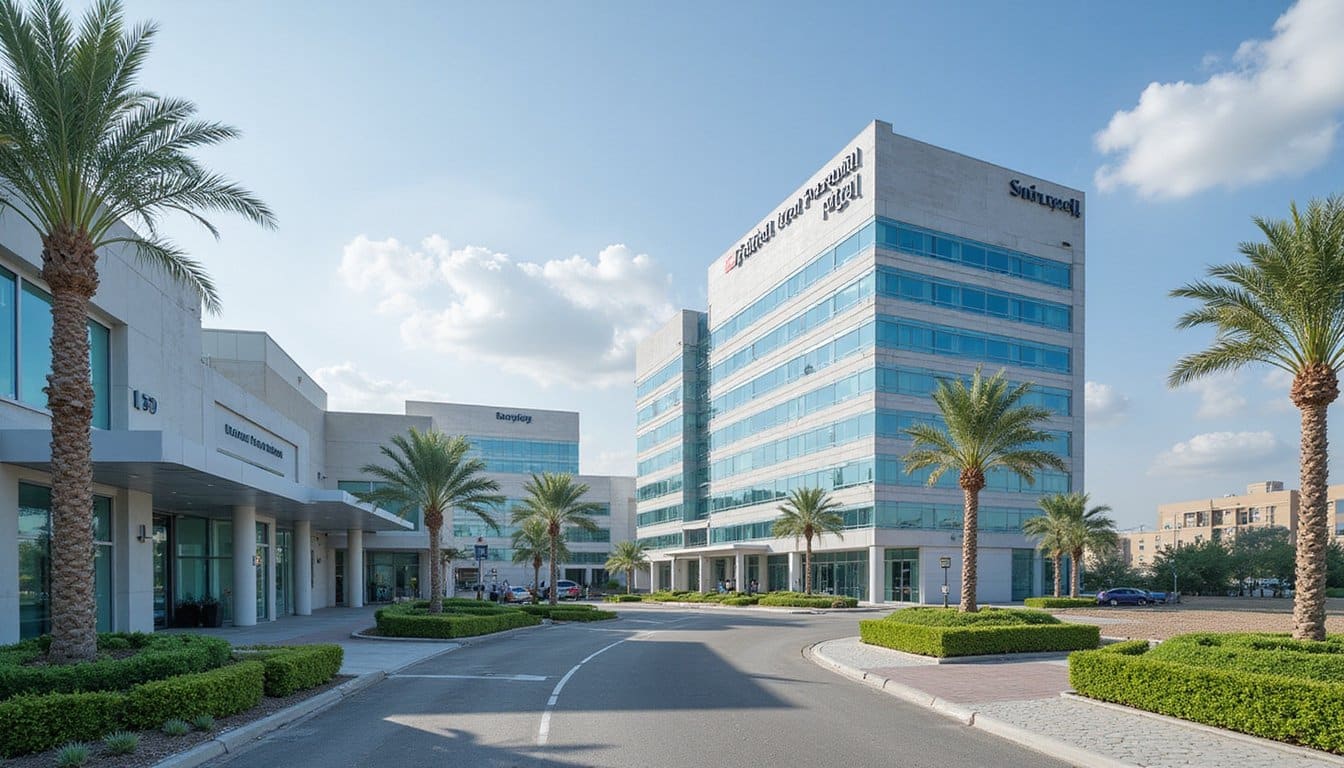
Because Dubai’s medical complexes are purpose-built around clinical workflow rather than retrofitted from generic office space, they deliver measurable efficiency gains at every operational layer. Efficient space planning doctors rely on includes modular furniture arrangements, hidden storage systems, and layouts that minimize staff transit time between reception, diagnostic, and consultation zones. Confidencebuilding experiences in Dubai contribute significantly to the overall patient satisfaction.
Patient flow management drives architectural decisions, strategic positioning of waiting areas and consultation rooms eliminates bottlenecks, while integrated EHR systems enable real-time record access across workstations. These digitized systems also support improved coordination of care by giving every provider instant access to medical histories and lab results regardless of which workstation they occupy. Regulatory compliance and authority-approved design guarantees every facility meets Dubai Health Authority guidelines, Civil Defence standards, and infection control protocols before opening. Combined with a Dubai transport system for doctors that connects residential and clinical zones seamlessly, these complexes convert structural precision into protected clinical time.
AI and Blockchain Tools That Cut Admin Time in Half
Although Dubai’s medical complexes already streamline physical workflow, AI-powered documentation tools now target the administrative layer that still consumes a disproportionate share of physicians’ time. AI scribes capture clinical encounters in real time, converting conversations into structured notes and reducing documentation burden by up to fifty percent. This reclaimed time compounds the efficiency gains Dubai modern infrastructure healthcare professionals already experience through reduced commuting in Dubai for doctors.
However, the evidence base for blockchain-specific administrative tools remains insufficient for policy-level analysis. While minimized travel time in Dubai doctors experience supports faster schedules, blockchain claims require further verification. What’s clear is that AI documentation, paired with an accessible city Dubai doctors navigate efficiently, creates measurable reductions in non-clinical workload across practice settings. Time management strategies for Dubai doctors can significantly enhance productivity and improve patient care. Implementing these strategies allows for better organization of daily tasks, ultimately leading to a more efficient workflow.
New Healthcare Infrastructure Projects Launching by 2027

While AI tools compress the administrative layer of clinical work, Dubai’s physical infrastructure pipeline targets the structural capacity constraints that no software update can solve. Among the most significant new healthcare infrastructure projects, Arabian Healthcare Group‘s 209-bed multispecialty hospital in Ras Al Khaimah spans 41,767 square meters along E311, with completion targeted for November 2027.
Closer to practice, DHCC’s 5,800-square-meter medical complex offers modular surgical, diagnostic, and outpatient spaces through shell-and-core architecture. These developments demonstrate how dubai infrastructure benefits doctors through purpose-built clinical environments. Dubai urban planning doctors lifestyle improvements extend to expat doctors commuting dubai via Salik-integrated smart parking and EV-equipped multi-storey facilities. Combined, AED 1.3 billion in Phase 1 investment directly expands where and how efficiently you practice.
Thinking About a Move to the Middle East?
Working as a doctor in Dubai comes with a quality of life that most people only dream about. Allocation Assist has been placing Western-trained doctors in Dubai and throughout the Gulf for over ten years, matching each doctor with a position that truly fits. If you want to explore your options, reach out and we will find the right opportunity for you.
Frequently Asked Questions
How Affordable Is Housing Near Major Healthcare Facilities for Doctors in Dubai?
You’ll find housing near major healthcare facilities quite accessible in Dubai. DHCC offers rentals starting at 95,000 AED annually, with options ranging up to 750,000 AED. If you’re buying, apartments begin at 1,190,000 AED, while studios start from 1 million AED. You’re positioned within 230, 600 meters of key hospitals like Mediclinic City and Dr. Sulaiman Al Habib, ensuring you’ve got affordable, strategically located housing that supports your demanding schedule.
What Visa Benefits Does Dubai Offer to Foreign-Qualified Medical Professionals?
Dubai offers you a 10-year renewable Golden Visa under Federal Decree-Law No. 29 of 2021, granting residency without employer sponsorship. You’ll practice independently, own healthcare businesses, and sponsor your spouse, children, and parents without age restrictions. You’re eligible if you hold a valid license from DHA, MOHAP, or DOH. The Permit to Practice Initiative also lets you work without obtaining a full UAE medical license.
Are International Medical Degrees Recognized Without Additional Licensing Exams in Dubai?
No, Dubai doesn’t automatically recognize international medical degrees without additional licensing. You’ll need to pass the DHA licensing exam, a 150-question Prometric assessment with first-time pass rates of 50-70%. However, if you hold USMLE Step 3 certification and an active US state license, you may qualify for exam exemptions. You must also complete mandatory DataFlow Primary Source Verification before gaining eligibility, regardless of your credentials’ origin.
How Do Dubai’s Tax-Free Salaries Compare to Other Global Healthcare Markets?
You’ll retain 100% of your earnings in Dubai, giving you 40-45% higher net pay than equivalent roles in the UK, US, or Australia. Specialists earning AED 40,000-70,000 monthly outpace US counterparts earning $15,000-$25,000 pre-tax. When you factor in mandatory housing allowances, end-of-service gratuity, and education coverage, your total compensation package rises 60-80% beyond base salary, a structural advantage no taxed jurisdiction currently matches.
What Schooling Options Exist for Doctors Relocating to Dubai With Families?
You’ll find over 216 private schools offering 17 curricula, including British A-Levels, American AP, and IB programs. Sixty-six IB World Schools serve ages 3, 19, and 23 schools hold Outstanding KHDA ratings. You can expect 95% university placement rates at top global institutions. Schools like Dubai College and Jumeirah English Speaking School consistently achieve academic ratings above 95%. With 77% of students attending Good-rated institutions or better, your children’s education remains competitively positioned.