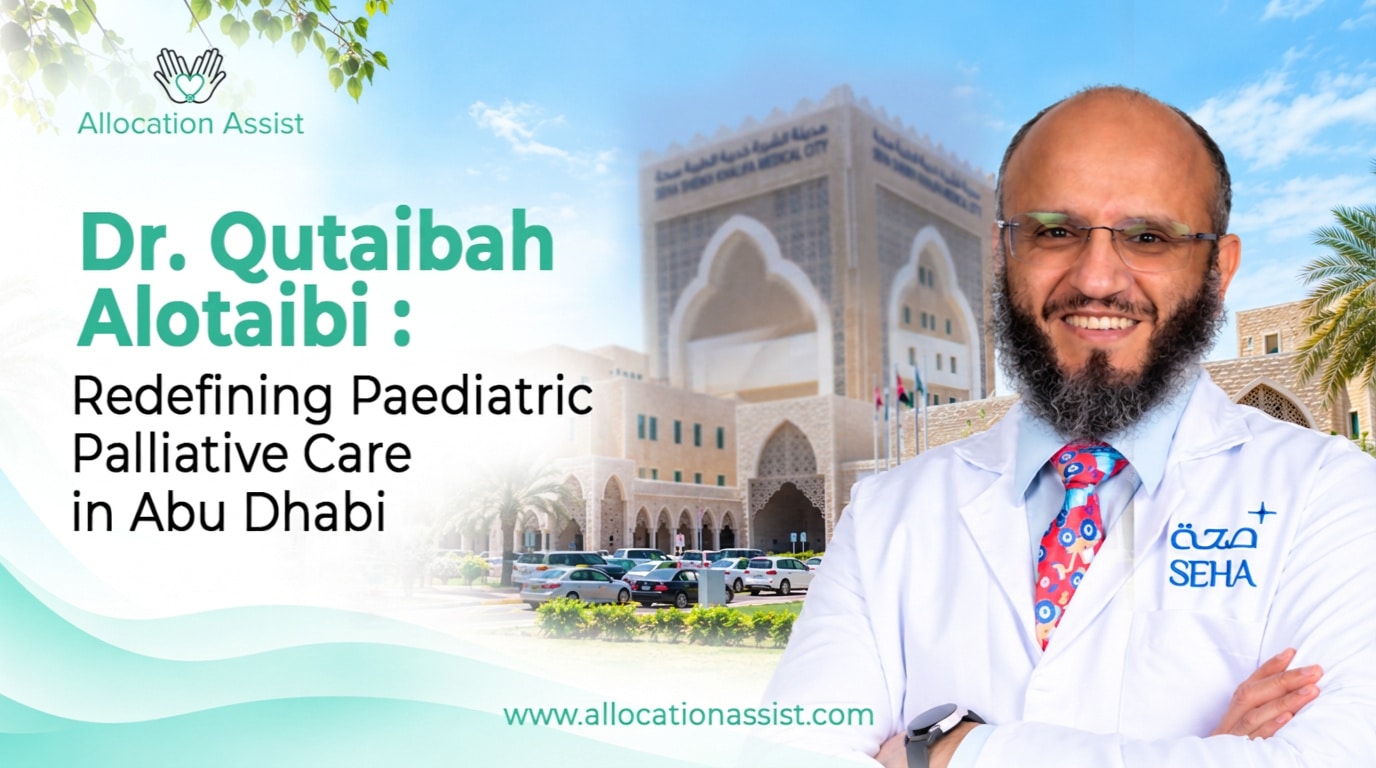
A doctor walks into a room. A child looks up. Then comes the small, unmistakable moment when a smile appears. For Dr. Qutaibah Alotaibi, Consultant in Paediatric Palliative Care at SEHA Sheikh Khalifa Medical City, that moment is everything, and it sits at the centre of how he is building paediatric palliative care in Abu Dhabi. Asked what he finds most fulfilling about his work, he did not hesitate:
“It’s always the smiles.”
Who Is Dr. Qutaibah Alotaibi?
Dr. Alotaibi wants children living with serious illness to feel as comfortable and as happy as possible. One resident he works with once told him they had never seen children with cancer smile when a doctor walked into the room, until now.
That kind of care is not learned from a textbook. It comes from someone who cares deeply, backed by a career built with great intention.
What Training Prepared Him for This Specialty?
He trained in medicine at the Royal College of Surgeons in Ireland and completed the Saudi Board in Paediatrics. He then earned a Postgraduate Diploma in Palliative Medicine from Cardiff University.
His advanced fellowship training spanned three Canadian institutions: the University of British Columbia in Vancouver, the University of Calgary and the University of Alberta in Edmonton. That took him through children’s hospices and one of Canada’s major children’s hospitals.
What Did He Build Before Moving to Abu Dhabi?
Back in Kuwait, he established the country’s first in-hospital paediatric palliative care service. He also led the Complex Care Unit at Al-Adan Hospital, guiding physicians, nurses, social workers and allied health professionals.
He publishes research, presents across the region and beyond, and teaches junior doctors, residents and nurses at the bedside. Colleagues turn to him when the work is most demanding.
Why Did He Choose Sheikh Khalifa Medical City?
Paediatric palliative care is a niche field and often misunderstood. In earlier roles, he spent much of his time explaining the specialty and advocating for it, while only using a small part of what he could offer.
Abu Dhabi was different. Sheikh Khalifa Medical City had a clear understanding of the service’s purpose: better comfort and symptom care for children with serious illness. That clarity was one of the main reasons he said yes.
What Does His Role Cover Today?
He was first expected to work mainly with oncology but was given the chance to expand. He now represents the Paediatric Palliative Care Service within the General Paediatrics Department, working across subspecialties including the ICU and cardiac ICU.
For now, he is essentially a one-person team, yet he rarely feels like one. Colleagues welcomed him, departments opened their doors and there was a real willingness to care for children together. That, he says, is exactly the setting where the specialty can grow.
What Can Paediatric Palliative Care Offer Families?
Palliative care is still often seen narrowly. Dr. Alotaibi sees it as comfort, symptom management and pain management delivered alongside a child’s ongoing treatment for serious illness.
He helps families choose comfort, so children face fewer unnecessary admissions and invasive procedures, and care stays dignified and centred on the child. The aim is to make the hardest days gentler for children and the families who love them.
Is the Gulf a Good Fit for Doctors in Rare Specialties?
His move was not simply for another consultant post. He found a hospital that understood a rare field he had spent years championing and trusted him to help develop it. For doctors whose expertise is not yet well established in the region, he believes the scope is real:
“It’s the best place you could actually create a legacy from.”
Doctors heading to the capital are licensed by the Department of Health, so the DOH licence is the first step, and the wider group of Abu Dhabi hospitals includes both SEHA facilities and private groups.
How Allocation Assist Supports Doctors in Specialised Fields
Dr. Alotaibi needed a hospital that understood his specialty, not just a vacancy. Matching rare expertise with the right institution sits at the centre of Allocation Assist’s work. It is a medical jobs consultancy with a strong record in doctor placement in Abu Dhabi, supporting Western-trained doctors across the UAE, Saudi Arabia and Qatar for over 11 years with a network of 95+ hospitals. Specialists in niche fields can contact us or call +971 4 273 3477.
Key Areas of Support
- Hospital matching: identifying hospitals ready to build services in your field.
- Licensing and regulatory navigation: DOH credentialing, plus DHA, MOHAP and SCFHS where your role requires it.
- Interview and salary negotiation support: presenting the service you could build and agreeing terms that reflect it.
- Relocation and family logistics: housing, schools and settling your family into a new city.
- Ongoing support after you arrive: support as your service grows and your team expands.
Frequently Asked Questions
Is paediatric palliative care only for end of life?
No. It provides comfort, pain relief and symptom management alongside a child’s ongoing treatment for a serious illness, making difficult days easier for children and families.
What is the difference between palliative care and hospice care?
Palliative care can start at any stage of a serious illness and run alongside treatment, while hospice care focuses on comfort when treatment aimed at cure has stopped.
Is there demand for paediatric consultants in Abu Dhabi?
Yes. Paediatrics is among the specialties in demand across Abu Dhabi, alongside cardiology, oncology, emergency medicine and intensive care.
How do doctors join a SEHA hospital?
Create a TAMM profile, complete DataFlow verification and DOH credentialing, and the hospital activates your licence once it makes an offer.
Do UK doctors need to sit an exam for a DOH licence?
Usually not. Specialists with a recognised certificate from countries such as the UK can be exempt from the DOH exam, provided they have not had a practice gap of more than three years.
How much do consultants earn in Abu Dhabi?
Consultant roles commonly pay around AED 70,000 to 90,000 a month, tax free. Packages often add accommodation, schooling, flights, medical insurance and 30 days of paid leave.