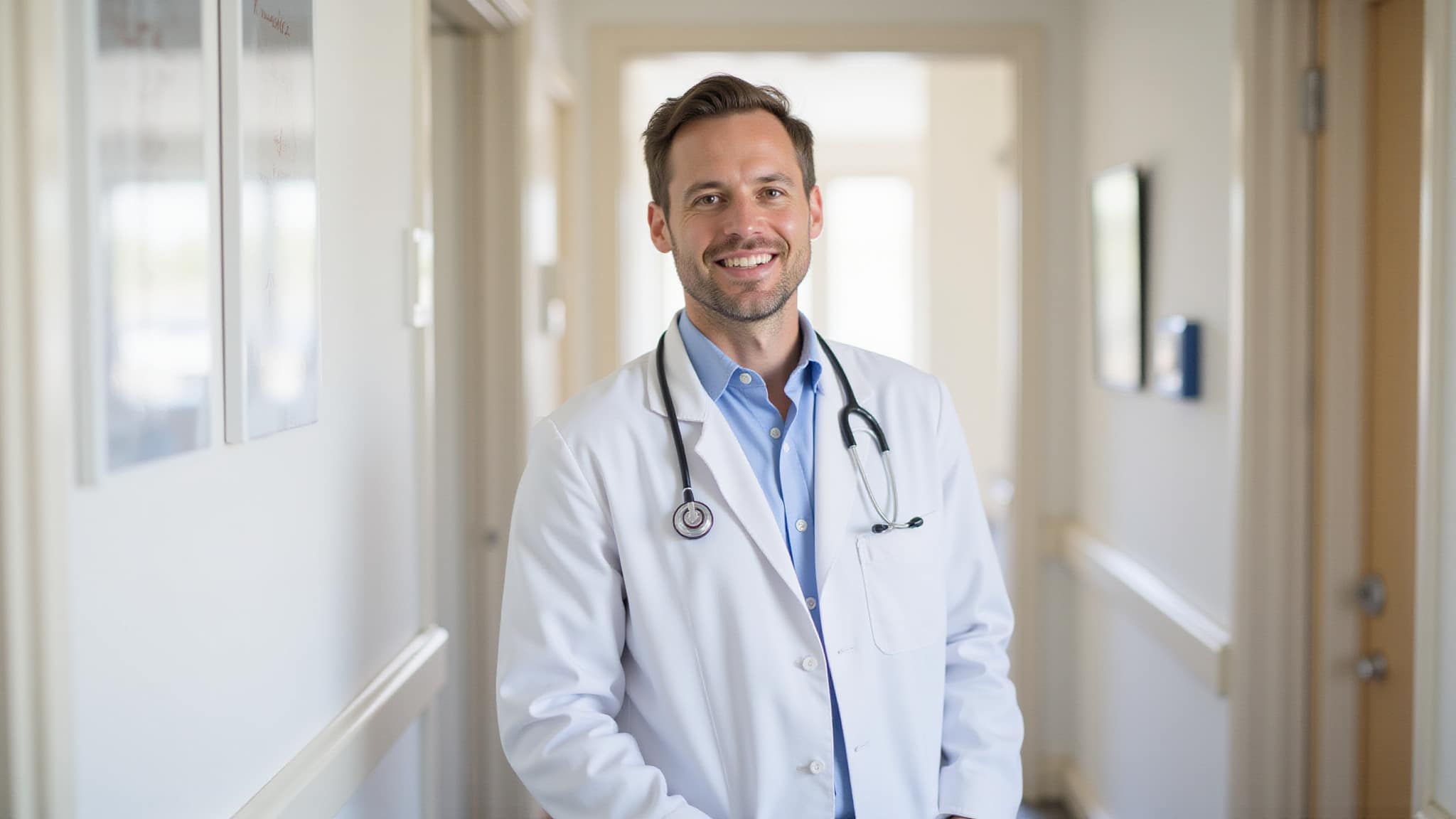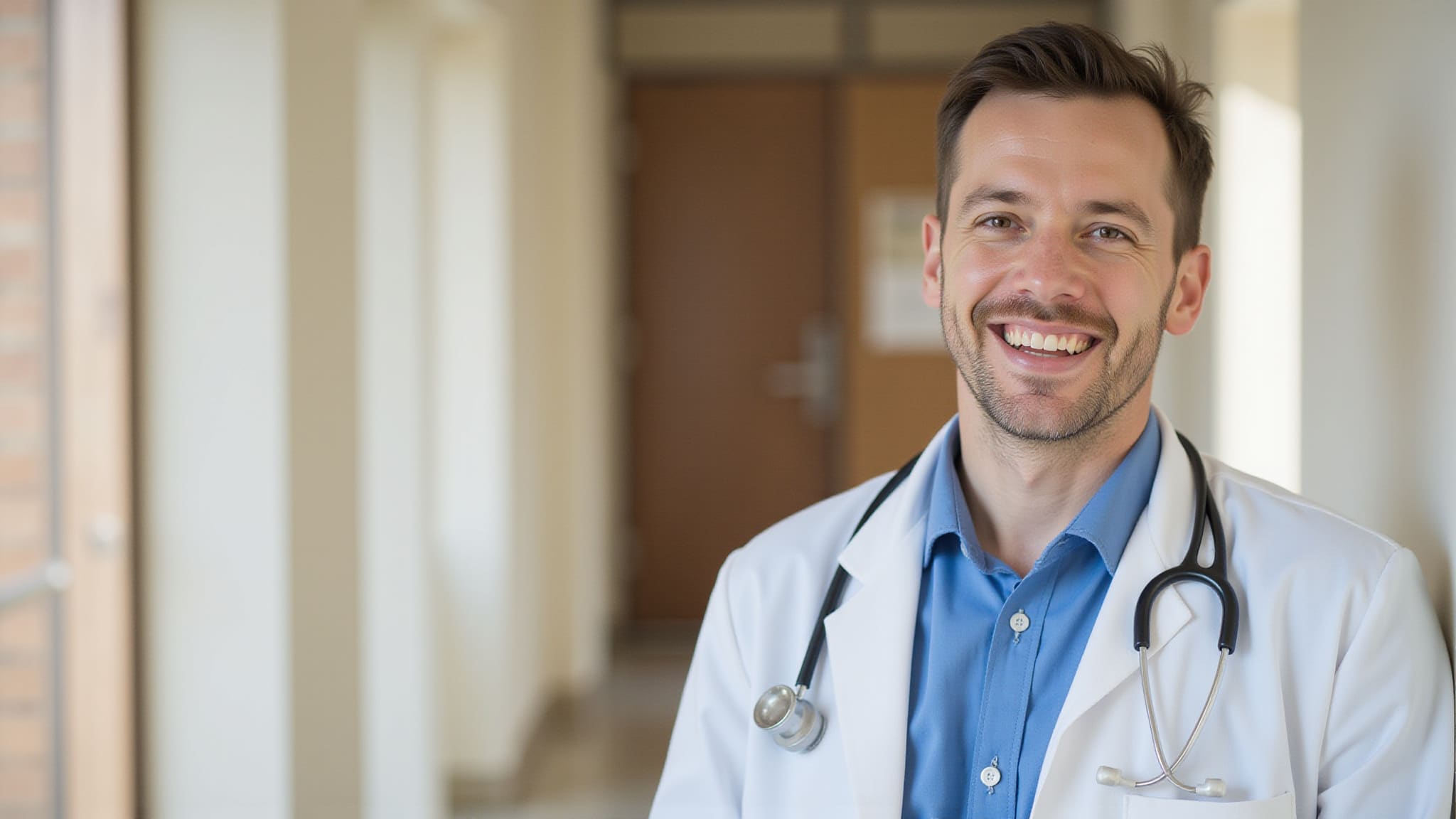
More US physicians are moving to Dubai for reasons that have little to do with escape and more to do with growth: higher take-home pay, less administrative load, and a healthcare system still being built rather than maintained. Dr. Shajeer Noor, a consultant neonatologist who trained and practiced in the United States for nearly two decades, is one of them. His full story appears in the original feature on LinkedIn, Why This Houston Neonatologist Decided to Move to Dubai. What follows is why an established American doctor looked to the Gulf, and what the move actually involved.
Why Do Established US Physicians Leave Successful Careers?
It rarely arrives as a crisis. For many established doctors, it is quieter than burnout and harder to name, the sense of having settled somewhere comfortable and mistaking comfortable for fine. The signal shows up in the numbers too. As of 2025, around 42% of US physicians report burnout, down from pandemic highs above 60% but still close to half the profession, and the driver is consistent. It is not the medicine. It is the documentation, the administration, and the widening gap between what doctors are trained to do and what their days actually demand.
Dr. Noor knew the feeling from the inside. He was board-certified in pediatrics and neonatal-perinatal medicine, teaching residents at UTMB, co-authoring antibiotic stewardship protocols, and covering four NICUs across Houston through Pediatrix Medical Group. By any external measure, his career was complete. What was missing was room to keep growing.
“I was finding that I wasn’t really growing as a professional. And I wanted the opportunity to grow, professionally and as a person. I was not finding where I was.”
What Made the UAE the Right Move, Not Just a Familiar One?
He had family across Saudi Arabia, Qatar, and the UAE, and he grew up partly in Muscat, but he treated that as background rather than a reason. He delved into the sector first. The UAE healthcare market sat at $24.8 billion in 2023 and is projected to reach $40.5 billion by 2030, and the wider GCC is short more than 60,000 healthcare professionals. For a specialist, those numbers are the difference between being needed and being ornamental.
Senior specialists moving to Abu Dhabi can significantly alleviate the pressure on the healthcare system, and this influx of skilled professionals is vital in addressing the growing demand for quality care in the region. Why Dr. Tiago Moreira’s move to Abu Dhabi offers a clear example of how specialists are advancing their careers here. With numerous hospitals and healthcare facilities expanding their services, the demand for specialized skills continues to grow.
When Allocation Assist put Mediclinic City Hospital in front of him, he interviewed the way he approaches most things, listening as much as he was being listened to.
“It seemed fast-paced, cutting edge. People were reporting good work-life balance. There were plenty of opportunities to make your mark.”
How Does Physician Pay and Tax Compare With the US?
This is the first thing most physicians want to understand, usually on the assumption that the US government will claw back whatever they gain by leaving. The reality is more favorable. There is no local income tax in the UAE, and a US citizen working for a non-American employer abroad can use the Foreign Earned Income Exclusion.
“Here, we don’t have income tax locally. And as an expat working for a non-American employer, you can qualify for what’s called the Foreign Earned Income Exclusion. In the last tax year it was around $126,000 you could exclude when calculating your taxes. For 2025 that figure is $130,000. You pay taxes on the difference above that threshold.”
On top of that, the 7.65% normally taken from every American paycheck for Social Security and Medicare does not apply when working for a foreign employer abroad, and Dubai’s VAT sits at 5%, lower than the 6 to 10% sales tax common across US states.
| Cost or deduction | United States | UAE (Dubai) |
|---|---|---|
| Local income tax | Federal and often state tax applies | None |
| FICA (Social Security + Medicare) | 7.65% of every paycheck | Not deducted (foreign employer) |
| Foreign Earned Income Exclusion | Not applicable | Up to $130,000 excluded (2025) |
| Sales tax / VAT | 6 to 10% on average | 5% |
It is not effortless. The exclusion requires 330 days of residence abroad to qualify, so a mid-year move needs planning, and Dr. Noor’s advice on that is direct.
“I would highly encourage any physician planning to move to talk to a tax professional before they move. Plan at least six months ahead. The rules are in your favour. You just need someone who knows how to use them.”
What Is Family Life and Schooling Like in Dubai?
Dr. Noor moved with his wife and two children. He placed them in a British curriculum school for the academic rigor, after finding they were performing well in Houston without being challenged. The standard held up: 73% of Dubai’s private schools were rated Good or Outstanding by the KHDA in its most recent annual report. Schooling does cost more than it did in Houston, which is part of why the tax and salary structure matters so much when planning the move.
What surprised him more was the everyday freedom.
“My kids just walk out the door and go play with their friends in the compound. You’re not going to see that in the US these days.”
Dubai consistently ranks among the world’s safest cities on Numbeo’s Safety Index, with low crime levels, and his wife feels safe going out alone.
Is Dubai Safe for Expat Physicians During Regional Tension?
During a period serious enough for the US Embassy to advise American citizens to leave the UAE, Dr. Noor stayed, not out of stubbornness but from a considered read of where he was living.
“The government was sending notifications. When it’s safe to go in, when it’s safe to go out. The leadership here has planned for the future. They have strategic reserves, they have built-in resilience.”
He points to a track record. The UAE recorded a 99% adult vaccination rate during COVID, the highest globally, and ranked first worldwide for rollout speed. When Dubai flooded, the infrastructure held and recovery was fast. His own comparison is the hurricanes his family faced every few years in Houston: difficult conditions are not unique to the Gulf. Is a Gulf move right for you? Many are drawn to the region for its unique lifestyle and opportunities. However, it’s essential to weigh the pros and cons before making such a significant decision.
What Made the Move Itself Work?
Placing a physician into a foreign hospital system involves a lot of moving parts, and plenty of firms handle them poorly. What stood out to Dr. Noor was simple. Why radiologist Dr. Dheeraj Giri’s move to Dubai has captured attention is due to the unique opportunities available in the region. The growing healthcare sector in Dubai presents a chance for specialists to expand their practice in a thriving environment.
“Professionalism, organisation, and communication. Those three things make a huge difference. When they didn’t have an answer, they researched it. I don’t want Google answers. I want people who actually do the work.”
The practical sequence he followed is worth copying: research the market, run the tax position with a professional well in advance, and work with a placement partner who knows the hospitals and the questions a physician has not thought to ask yet. He has since referred a colleague, a critical care pulmonologist, who now knows who to call.
Thinking About Relocating to Dubai?
Relocating to the UAE is a major step, and it goes far more smoothly with the right team beside you. At Allocation Assist, we help doctors at every point of the process, from reading up in Relocating to Dubai to practical support with our DHA license consultancy. If you would like to talk it through, you can book a free consultation.
Frequently Asked Questions
Do US-licensed doctors pay income tax in the UAE?
There is no local income tax in the UAE. US citizens still file with the IRS, but the Foreign Earned Income Exclusion allows up to $130,000 of foreign income to be excluded for 2025, and FICA deductions do not apply when working for a foreign employer abroad.
Is Dubai safe for physicians and their families?
Dubai ranks among the world’s safest cities on Numbeo’s Safety Index, with low crime levels. The UAE also has a strong record of institutional response, including a 99% adult COVID vaccination rate.
Why is there demand for US-trained physicians in the UAE?
The UAE healthcare market is growing from $24.8 billion in 2023 toward a projected $40.5 billion by 2030, and the wider GCC is short more than 60,000 healthcare professionals, so specialists are in genuine demand rather than surplus.
What is the Foreign Earned Income Exclusion for 2025?
For 2025, the exclusion covers up to $130,000 of foreign-earned income. Qualifying generally requires 330 days of residence abroad, so physicians are usually advised to consult a tax professional at least six months before moving.
How good are Dubai’s schools for doctors relocating with children?
In the most recent KHDA annual report, 73% of Dubai’s private schools were rated Good or Outstanding, with a range of curricula, including British. Schooling typically costs more than in the US, which is one reason the tax and salary structure matters when planning a move.
How far ahead should a physician plan the move?
Physicians are generally advised to begin at least six months ahead, partly to meet the 330-day residence rule that the Foreign Earned Income Exclusion depends on. Consulting a tax professional early is recommended, and working with an experienced placement partner shortens the rest of the process.