You’ll find Dubai’s surgical practice differs from European settings in several key ways. Your DHA license ties you to a specific employer facility rather than allowing independent practice, and you’ll document cases in a chronological logbook rather than the UEMS credit-point system. While you’ll encounter faster patient turnover and often superior surgical technology, your performance metrics directly influence contract renewals. Understanding the surgical practice expectations for European surgeons moving to Dubai and these differences helps you prepare for what comes next.
DHA Licensing vs. European Medical Boards: Key Differences

When you’re moving from European practice to Dubai, you’ll quickly notice that DHA licensing operates under a fundamentally different structure than what you’ve experienced back home. The Dubai Health Authority functions as a centralized regulator, whereas European surgeons dubai typically navigate fragmented national boards like the GMC or Ordre des Médecins. Living and working in Dubai as a European doctor can be an enriching experience. The diverse patient population provides unique opportunities for professional growth. Career growth for European doctors in Dubai is supported by a robust healthcare infrastructure and a growing demand for specialized medical services. Networking opportunities with local and international professionals can further enhance career prospects.
For surgeons relocating to dubai, your European board certification won’t automatically transfer. DHA classifies qualifications through its own system and requires Primary Source Verification via Dataflow. Unlike European boards emphasizing CPD credits, DHA demands a two-year procedural logbook signed by your Medical Director. Additionally, you may need to clear assessments or examinations to demonstrate your competence and proficiency before receiving authorization.
Your license ties directly to your employer facility, a stark contrast to European practice’s portable registration. This means you cannot practice independently, as license activation requires an employer sponsorship through their registered healthcare facility. Understanding these distinctions helps surgical practice uae expats navigate their move efficiently.
Logbook and Documentation Requirements for European Surgeons
Although European surgeons maintain detailed procedural logbooks throughout their training and practice, DHA requirements differ considerably in structure and verification standards. Your UEMS logbook tracks credit points across procedure categories, requiring expert signatures per intervention. DHA demands a thorough two-year surgical record authenticated by your medical director’s signature and official hospital stamp.
| European Standard | DHA Requirement |
|---|---|
| Credit point system (minimum 800) | Chronological case listing |
| Independent expert signatures | Medical director authentication |
You’ll need to document exact surgery dates, your specific role, and patient outcomes for every procedure. DHA doesn’t accept the abbreviated format common in European training programs. Prepare entries with precise details, case specifics, complications, and post-operative results. Your European logbook must include essential identifiers such as patient initials or admission numbers, procedure type, date, and expert signature to meet UEMS criteria before translation for DHA review. Ensure professional formatting that adheres to UAE medical council standards, which differ substantially from European documentation conventions. Your surgical logbook serves as a cornerstone of the DHA licensing process, demonstrating your practical experience and commitment to quality patient care in Dubai’s healthcare market.
The DHA Oral Exam: What European Surgeons Face

Beyond documentation, the DHA oral exam represents your next significant hurdle, and it differs markedly from European board assessments you’ve encountered.
The exam uses clinical scenario-based questioning, presenting minimum five cases relevant to your surgical specialty. You’ll face a panel of licensed healthcare professionals who evaluate your decision-making through real-world situations, not theoretical knowledge alone. The computer-based portion you must pass first consists of 150 questions to complete within the allotted examination time.
Key structural differences from European assessments:
- Pass threshold: 60% required, lower than many European board standards
- Attempt limits: Maximum three tries across CBT and oral components combined
- Delivery format: Virtual platform standard, though DHA may require in-person attendance
You must pass the computer-based test first. Fail the CBT three times, and you’re blocked from the oral portion entirely. It’s worth noting that the DHA does not release past papers or original exam questions, so you’ll need to rely on compiled resources and feedback-based question banks from medical education providers for your preparation. Plan your preparation strategy accordingly.
Your DHA Licensing Timeline From Application to Surgery
Since you’ve cleared the oral exam, your focus shifts to traversing the DHA licensing process, a multi-stage journey that typically spans 8-12 weeks from initial application to practicing surgery in Dubai.
From oral exam success to practicing surgery in Dubai, expect an 8-12 week journey through the DHA licensing process.
Your timeline breaks down into distinct phases. Sheryan account creation takes 1-2 days, while Dataflow’s Primary Source Verification requires 25-45 working days, though express processing cuts this to 14 days. Once Dataflow clears your credentials, DHA eligibility review adds another 10-15 business days.
Unlike European systems where hospital credentialing often runs parallel to licensing, Dubai’s process is sequential. You’ll pay AED 3,020 for your specialist registration fee, then submit your job offer from a DHA-approved facility. Final license activation completes within 2-5 working days. All documentation submitted through the Sheryan Portal must be in English or Arabic, requiring official translations for any credentials in other languages. Keep in mind that all DHA licensing fees are non-refundable, even if your application is rejected, so ensuring document accuracy from the start is essential.
Planning strategically means initiating Dataflow verification immediately after passing your oral examination.
What Surgical Practice Looks Like Under a DHA License
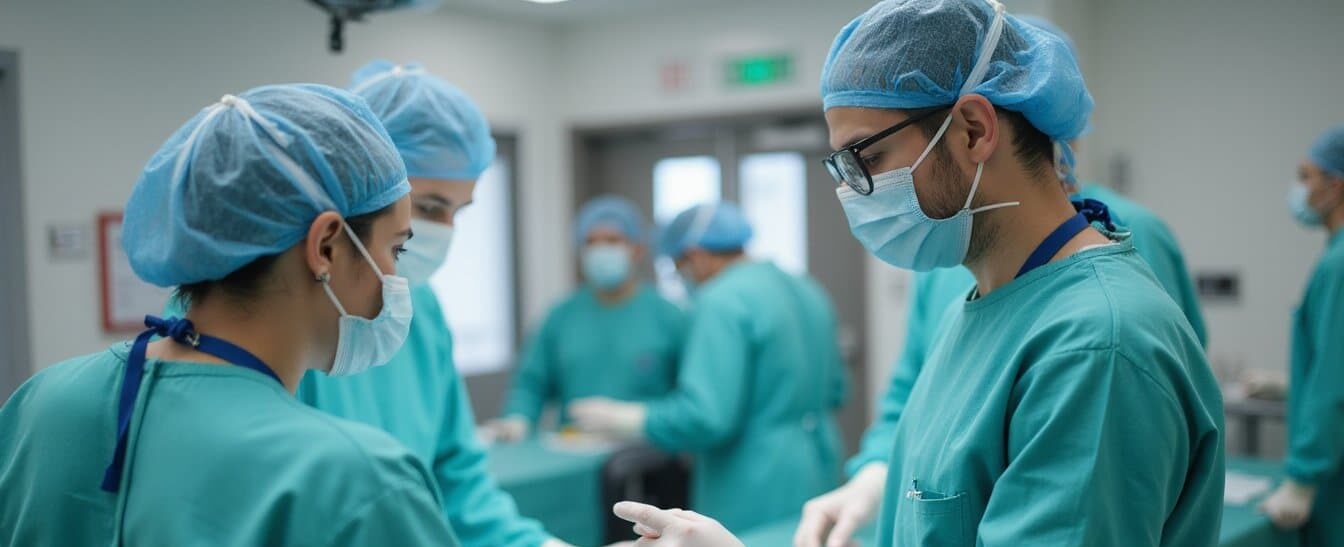
Once your DHA license activates, you’ll find surgical practice in Dubai operates differently than European systems in several key ways.
You’re authorized to perform procedures only at DHA-licensed facilities, ensuring standardized patient safety protocols. Unlike public healthcare systems, Dubai emphasizes elective procedures and private patient care, shifting your caseload composition considerably.
Key practice differences include:
- Performance metrics directly influence your practice trajectory and contract renewals
- Technology access exceeds many European settings, with advanced surgical equipment widely available
- Scheduling models favor efficiency, requiring adaptation to faster patient turnover
You must maintain a detailed surgical logbook documenting procedures as primary surgeon, this isn’t optional. DHA requires this documentation for license renewal, making consistent record-keeping essential from day one. Compliance with DHA guidelines remains mandatory throughout your practice. Since DHA licenses are valid for 1-2 years, planning your renewal timeline ensures uninterrupted surgical privileges at your facility.
As a European surgeon, your training and precision carry a reputation that Dubai’s top hospitals are actively seeking. The opportunity is real, and so is the demand. At Allocation Assist, we connect European surgeons with prestigious hospitals where their skills are not just needed but deeply respected. Our job placement service takes the guesswork out of the search, so you can focus on what you do best. Book your free consultation today at (+971) 4 273 3477 and let us help you find where your expertise truly belongs.
Ready to Bring Your Specialty to Dubai?
Every specialty has its own route into the UAE, and it helps to have someone guide you through yours. At Allocation Assist, we help doctors at every point of the process, from reading up in Working as a Doctor in the UAE: A Guide to practical support with our DHA license consultancy. If you would like to talk it through, you can book a free consultation.
Frequently Asked Questions
Can I Maintain My European Medical License While Practicing in Dubai?
You can typically maintain your European medical license while practicing in Dubai, as most European medical boards allow dual registration. However, you’ll need to meet your home country’s requirements for license renewal, which may include continuing education credits or periodic revalidation. Dubai’s DHA license operates independently from your European credentials. Check your specific national medical board’s regulations regarding practicing abroad, as requirements vary between European countries.
How Do Dubai Surgical Salaries Compare to European Healthcare Systems?
Dubai surgical salaries greatly exceed European healthcare systems, primarily due to tax-free income. You’ll earn AED 72,000, 160,000 monthly depending on specialty, compared to heavily taxed European equivalents. Neurosurgeons and cardiothoracic surgeons command the highest rates. Beyond base pay, you’ll receive housing allowances, education benefits, and annual flights, benefits rarely matched in European public systems. Private sector roles offer even higher compensation, with revenue-based models pushing earnings to AED 100,000+ monthly. Working as a specialist in Dubai hospitals not only enhances your income potential but also provides opportunities for advanced medical training. The vibrant healthcare sector attracts professionals from around the world, fostering a collaborative environment where expertise is shared.
What Malpractice Insurance Coverage Is Required for Surgeons in Dubai?
You must carry mandatory malpractice insurance under Federal Law No. 4 of 2016, there’s no practicing without it. DHA requires minimum coverage of AED 1,000,000 per claim and AED 3,000,000 annually, though surgeons typically need higher limits given their risk profile. Unlike many European systems where employer indemnity dominates, your Dubai facility provides and pays for this coverage. You’ll find limits customizable up to AED 20,000,000 based on specialty.
Are European Surgical Techniques and Protocols Accepted in Dubai Hospitals?
Yes, Dubai hospitals widely accept European surgical techniques and protocols. You’ll find familiar standards, as facilities like American Hospital Dubai adapt credentialing criteria from international models. Your laparoscopic and open surgery skills transfer directly, though you should expect emphasis on robotic platforms, da Vinci and Versius systems are now standard across major hospitals. You’ll undergo thorough credentialing before operating independently, but your European training provides a strong foundation for practice here.
Can My Spouse Also Obtain a Medical License to Practice in Dubai?
Yes, your spouse can obtain a DHA medical license through the same process you’ll follow. They’ll need to complete DataFlow verification, pass required exams based on their training country, and submit credentials through the Sheryan portal. Unlike your employer-sponsored pathway, they’ll need a job offer to activate their registration. You can sponsor their residency visa while they pursue licensing independently, giving them time to secure employment.