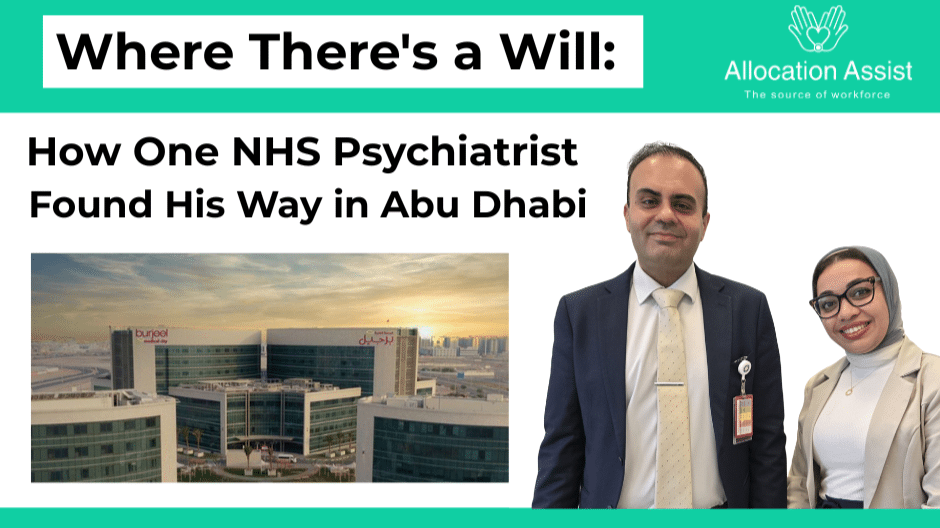
After 14 years in the NHS, Dr. Amir Javaid relocated to Abu Dhabi despite colleagues warning that psychiatry’s reliance on language could make the move difficult. His neurodevelopmental expertise in autism and intellectual disability proved to be a strong fit at Burjeel Medical City, where he helped expand mental health services. Clinical traction took 6, 8 months, but word-of-mouth referrals eventually filled and overbooked his clinics. His journey reveals what it actually takes to make a high-stakes career shift succeed.
The Warning Before the Move
After fourteen years in the NHS, Dr. Amir Javaid held seniority, stability, and an established career. Colleagues urged caution.
“It’s very difficult for non-Arabic speakers in psychiatry to succeed in the UAE due to the language barrier,” they warned.
With 60, 70% of Abu Dhabi’s population speaking Arabic primarily, and psychiatry deeply dependent on language, heeding warning seemed reasonable. Yet Dr. Javaid saw something beyond risk. “I always wanted to try something new… exciting, challenging, where I could utilise my leadership skills in different ways.” He chose traversing obstacles over comfort, trading certainty for possibility.
The Expertise That Changed Everything
Dr. Javaid didn’t just bring general psychiatry experience to Abu Dhabi. He brought something the region needed: specialized expertise in autism and intellectual disability, with training in conditions that even specialist physicians sometimes struggle to identify.
Psychiatry is particularly language-dependent. Unlike many medical specialties where physical examinations and imaging carry more weight, mental health care relies heavily on nuanced communication, cultural understanding, and the ability to build deep trust through conversation. For a non-Arabic speaker entering a market where 60-70% of the population speaks Arabic as their primary language, the challenge is real.
But when he joined Burjeel Medical City, the vision was already taking shape. “BMC’s CEO, Dr. Mujtaba Ali Khan, always wanted to expand mental health services and had neurodevelopmental disorders in mind,”
Dr. Javaid recalls.
“After I joined, he extended his full support to the psychiatry services and played an important role in the success, coming up with innovative ideas that helped grow the department.”
Dr. Mahesh, Head of Department of Rehab Services at BMC, had already begun planning autism services for the region. “When he interviewed me, he immediately saw that I could take this further. His trust, faith, and encouragement have been invaluable.”
That expertise became the foundation for something bigger than a private practice.
Within his first year, Dr. Javaid worked with the Department of Health as a specialist advisor, helped write guidelines for UAE’s national autism framework, and is actively involved with DOH along with the BMC team on the possibility of BMC becoming an autism hub in the future.
“Here at BMC, they value your skills and want you to grow and develop,” he says.
“They give you all the support professionally and personally when you’re establishing a unique service like autism. That’s how I ended up here.”
The Reality No One Mentions: It Takes Time
Dr. Javaid is careful not to paint an unrealistic picture. His first few months weren’t easy.
Abu Dhabi’s patient population is 60-70% Arabic-speaking. He’s a British-trained, non-Arabic-speaking psychiatrist in a field where cultural connection and language matter deeply. The warnings from his UK colleagues suddenly felt very real.
“It took me six to eight months minimum before my clinics were fully booked or overbooked,” he admits. “But that came through positive word of mouth, positive feedback from the families.”
The turning point came through the quality of care and outcomes he delivered. Families who saw results told other families. Patients brought relatives. Trust built slowly, then accelerated.
“I now have one family from Sharjah where I treat the mother, three daughters, and the son. They all have conditions that run in families, and once one person trusts you, they bring everyone.”
He’s also treating whole families in single sessions.
“Last week I had a father with ADHD, mother with depression, and children with ADHD. They make block bookings, four or five slots, and I become the family psychiatrist for some families. That’s what I really love.”
The hospital supported his visibility through media opportunities. Dubai One TV segments on men’s mental health, articles in Gulf News and Khaleej Times. But the real credibility came from clinical outcomes.
One Case That Expanded His Reach
One patient case expanded Dr. Javaid’s visibility across the region in ways no marketing campaign could.
A medical student, an American citizen with dual nationality, came to him with non-epileptic attack disorder. It’s a condition that mimics epileptic seizures but requires completely different treatment.
“I developed and established protocols locally for treatment of non-epileptic attack disorders during my time in the NHS,” Dr. Javaid explains.
“It’s challenging for any clinician because these seizures look very similar to true seizures, and treatment can be very difficult. Things become even more complicated when this co-exists with epilepsy.”
The patient was housebound for a year. She’d taken time off from medical school. Her family felt paralyzed, not knowing how to help.
Dr. Javaid treated her successfully. She returned to medical school. The family approached the hospital and media, and his article was published in Gulf News detailing the case and approach.
“Many similar cases followed after that,” he says.
What Actually Surprised Him
Dr. Javaid expected cultural barriers. He expected language challenges. What he didn’t expect was the warmth.
“I was thinking, ‘How will they perceive me as a foreigner, as a foreign-qualified doctor?’ But I was deeply touched by their humbleness and humility. They are very warm people. The way they respect you, remember you, admire you when you help them. I hadn’t seen that in other countries to the same degree in 17 years.”
He also didn’t expect the level of hospital support for innovation.
“They nurture you, give you the right support to develop, and don’t put any glass ceiling or restrictions as long as your ideas are proportionate and you’re able to execute them. That makes you feel happy. There’s real job satisfaction.”
In his first 14 months, he’s contributed to UAE’s national autism framework, worked with DOH on autism hub development, spoken at the Fifth Abu Dhabi Brain Conference with a 30-minute presentation to an international audience, presented at BMC’s neurology and epilepsy conference, started training residents, and built a practice treating families from all seven Emirates.
“Here, as long as you have intention and structure, you can build. With people like us in this region, we can establish education, create training programs, develop infrastructure. Why can’t it be done?”
He’s quick to acknowledge the support that made it possible.
“I’m grateful to BMC’s senior management. Dr. Mujtaba Ali Khan, our CEO, Dr. Mahesh, Head of Department of Rehab Services, and Dr. Fityan, our CMO. Their support and encouragement have been invaluable.”
A Different Kind of Practice
When asked to compare his experience, Dr. Javaid is thoughtful and balanced in his response.
“If you compare it with the UK, it’s less stressful,” he shares.
“Here, you have the resources and support to focus on patient care and development in ways that feel meaningful.”
He’s careful to acknowledge what the NHS offers as well. “The NHS has its own valuable strengths. Structured positions, plenty of opportunities for academic and clinical work at your own pace, strong research opportunities. Both systems have their merits.”
The technology in UAE also made an impact. “BMC and many other hospitals in the UAE have state-of-the-art technology. All the facilities are available in one facility. You don’t have to send patients to different places. Technology was an eye-opener for me.”
But more than the facilities, it was the space to grow.
“Here, they want you to be successful. They connect with you not only on a professional level but on a personal level. They cheer your achievements and they support you whenever you need it.”
What He’d Tell His Former Self
Fourteen months ago, Dr. Javaid was weighing a significant decision. He had comfort, seniority, and security in the NHS. The move to Abu Dhabi felt like stepping into the unknown.
Looking back now, he sees it as the right choice for where he wanted to take his career.
The journey from the NHS to the UAE wasn’t one he navigated alone.
“Working with Allocation Assist made a real difference,” he reflects.
“They connected me with the right opportunity and supported me throughout the entire process. When you’re making a major career move like this, having someone who understands what you’re looking for and guides you through each step matters.”
For psychiatrists worried about the Arabic language barrier, his advice is direct:
“Yes, it’s a challenge. But if you have expertise in a needed area, if you deliver quality care, and if you give the hospital time to support your visibility, word of mouth will build your practice. It takes six to eight months, not six to eight weeks.”
He pauses, then adds:
“I hope things remain like this. But I’m optimistic, because the foundation is there, the support is there, and the vision is there.”
Fourteen months ago, he was the one asking questions about whether this move would work. Today, he’s the one his former colleagues call when they’re considering the same decision.
The warning about language barriers? It wasn’t wrong. But it just wasn’t the whole story.
Thinking About a Move to the Middle East?
At Allocation Assist, we match your expertise with the right opportunity and support your family’s transition from start to finish. We’ve helped hundreds of Western-trained doctors build meaningful careers across UAE, Saudi Arabia, and Qatar.
Frequently Asked Questions
How do psychiatrists manage language barriers when working in international healthcare settings?
Language barriers can present challenges in psychiatry because communication is central to diagnosis and treatment. Many physicians rely on a combination of interpreters, culturally sensitive communication approaches, and building trust with patients and families to ensure effective care.
Do international physicians need additional licensing to practice in Abu Dhabi?
Physicians relocating to Abu Dhabi typically need to complete credential verification and obtain a license from the relevant health authority before practicing. Requirements vary depending on training background, experience, and specialty.
Are financial considerations an important factor for doctors moving from the NHS to the UAE?
Financial factors may play a role for some physicians considering a move abroad, but career decisions are often influenced by a range of factors, including professional growth, leadership opportunities, work environment, and access to advanced healthcare resources.
How do physicians and their families adapt to relocating internationally?
Relocating to a new country can involve adjustments for both physicians and their families. Many doctors consider factors such as lifestyle, schooling options, professional opportunities, and community support when making relocation decisions.
How long does the licensing process typically take for doctors moving to the UAE?
The licensing timeline can vary depending on the physician’s credentials, documentation, and the requirements of the relevant health authority. Many applicants begin the process several months before their planned start date to allow time for verification and approvals.