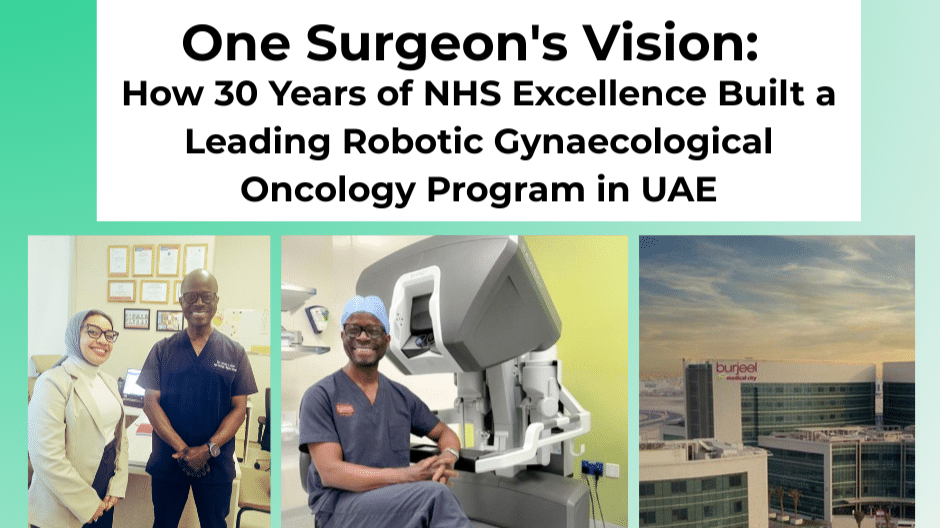
After 30 years in the NHS and 16 years as a consultant at Nottingham University Hospital, Dr. Jafaru Abu shifted to Burjeel Medical City in Abu Dhabi to build a robotic gynaecological oncology program from the ground up. He helped establish a robotic gynaecological oncology program at Burjeel Medical City, developing governance frameworks and training pathways for the Da Vinci Xi robotic system. His journey reveals how clinical excellence translates into entrepreneurial healthcare leadership across borders.
The Decision: Leaving Excellence to Build Excellence
At Nottingham University Hospital, Dr. Abu had everything a surgeon could want. He was the lead for gynaecological cancers, not just for the hospital but for parts of the region. He had a thriving private practice. He’d built a reputation over 30 years of dedicated NHS service.
“It was everything I’d built my career on,” he reflects.
But in early 2022, an opportunity emerged in Abu Dhabi. Burjeel Medical City was expanding rapidly, investing in cutting-edge technology, and looking for international experts to lead new programs.
The decision wasn’t easy. Leaving the NHS after 30 years meant walking away from established systems, trusted colleagues, and financial security. But walking away from a lucrative private practice? That was the truly brave decision.
Most surgeons at his level don’t make that choice. Private practice in the UK represents financial stability, professional prestige, decades of relationship-building. Dr. Abu left it all behind, not for money, but for impact.
He saw something others might have missed: the chance to create something transformative in a rapidly growing region. The chance to architect a program exactly as it should be, to train the next generation of surgeons, to bring world-class gynaecological oncology care to women across the Middle East.
“The approach to medical practice within the UAE is totally different,” he explains. “It’s more entrepreneurial, more focused on building and innovation.”
The financial reality mattered too. The UAE’s tax-free environment offered better savings potential than the UK’s 40-50% consultant tax rates. But Dr. Abu’s decision wasn’t driven by finances, it was driven by the opportunity to build something lasting.
In March 2022, he made the move.
Building From Vision: The First Year
What Dr. Abu discovered when he arrived was both challenging and exhilarating. The infrastructure was excellent. The investment was real. But the programs, protocols, and systems he’d need? Those were ready to be built.
For a gynaecological oncologist, the question isn’t just about infrastructure, it’s about cases. Would there be enough complex surgical oncology work to maintain his skills? The answer became clear quickly: the UAE’s rapidly growing population and expanding healthcare access meant significant demand for specialist care.
“When I came here, everything was dependent on me to design and implement,” he explains. “It required a different mindset than working within an established NHS framework. You need to think like a program director, not just a clinician.”
The NHS had given him 30 years of world-class training and experience. Now he’d use every bit of it to build something new.
His first priority: establishing outpatient services that would serve patients efficiently. Working with his nurse, Angie, Dr. Abu set up the colposcopy clinic from the ground up.
“Burjeel was ready to develop an outpatient colposcopy service. Patients would have to go through insurance approvals and have procedures done in operating theatres. Now patients come during their lunch break, have the procedure done in 10 minutes, and go.”
The difference was transformative. What once took weeks and required general anaesthesia now happens in a lunch hour with immediate results.
“The hospital provided all the equipment and support we needed,” he notes. “They were ready to invest in the vision. I just had to execute it.”
Pioneering Robotic Surgery: Building the Framework
Dr. Abu led the development of the robotic surgery program after Burjeel Medical City acquired the Da Vinci Xi system, launching robotic surgery in July, August 2023.
“Burjeel invested considerably in the technology and gave me the responsibility to establish governance guidelines and training pathways,” he stated.
| Training Phase | Component |
|---|---|
| Theoretical training development | Didactic coursework and governance protocols |
| Dry lab practice | Instrument handling and procedural simulation |
| Wet lab simulation | Tissue-based surgical technique refinement |
| Clinical case supervision | Proctored live procedures with structured assessment |
“You need clearly defined training pathways to guarantee excellence.”
This framework enabled hospital wide adoption across multiple surgical disciplines.
The Cultural Challenge: Building Trust Across Differences
When Dr. Abu arrived, skeptics warned him directly:
“Somebody told me the patients wouldn’t allow it.”
A male gynaecological oncologist practicing in a conservative region faced legitimate concerns about patient acceptance. He responded with cultural sensitivity and flexible approaches, offering female colleagues for examinations when needed while maintaining high standards of clinical care.
Patient trust followed. “When you show them you can compromise and respect their boundaries… that’s when they trust you.”
The emotional appreciation proved overwhelming.
“The flowers, chocolates and cards I’ve received from patients within four years outnumber what I received for 25-30 years in the UK.”
The Entrepreneurial Reality
Beyond clinical expertise, succeeding in the UAE demanded a fundamentally different professional identity, one closer to healthcare entrepreneur than salaried consultant. Dr. Abu navigated cultural differences while building his reputation and establishing new clinical programs in a rapidly growing healthcare environment. “You need to think like a program director, not just a clinician,” he emphasized. Visiting first to understand the real medical landscape proved essential, building reputation from scratch while competing in a new market required strategic thinking.
“Here, that’s exactly what’s needed. You advocate, you innovate, you create the ideal system because you’re the architect.” He acted as architect, not employee.
The Impact: Four Years Later
Four years after arriving in Abu Dhabi, the results speak in concrete clinical terms. Dr. Abu built a fully functioning outpatient colposcopy service, an established gynaecological oncology program, and a robotic surgery program spanning multiple specialties through multi disciplinary collaboration. Patient access improved significantly, lunch-break procedures replaced day surgeries. His regional reputation now draws patients from UAE, Oman, Bahrain, and beyond, while structured training programs guarantee lasting community impact.
“I revel in the challenge,” he says.
“When I eventually go back to the UK, I want to look back at my time here and say, yes, I’ve made an impact.”
About Dr. Jafaru Abu
Dr. Jafaru Abu brings 30 years of NHS leadership experience, including 16 years as a consultant at Nottingham University Hospital. As Consultant Gynaecological Oncologist and Director of Robotic Surgery at Burjeel Medical City, he pioneered the Da Vinci robotic surgery program and helped establish the hospital’s robotic gynaecological oncology service.
His career reflects:
- Entrepreneurial spirit in building a gynaecological oncology service from the ground up
- Cultural navigation as a male oncologist earning trust in a conservative region
- Patient-centered excellence rooted in evidence-based practice
Considering a Career Move to the Middle East?
Many accomplished consultants reach a point where they’re looking for something different. Perhaps it’s the chance to build programs with more autonomy, the opportunity to work with cutting-edge technology, or simply exploring what else is possible in their career. Whatever brings you to consider the Middle East, the transition requires proper support.
Dr. Abu’s journey shows what’s possible when decades of surgical excellence combine with clear vision and institutional support. At Allocation Assist, we’ve guided hundreds of Western-trained doctors through the complex transition to Middle East practice, from licensing and credentialing to finding the right institutional fit.
Whether you’re ready to pioneer innovative programs or advance your established practice, we connect you with premium hospitals across the UAE, Saudi Arabia, and Qatar.
Frequently Asked Questions
What Specific Visa or Licensing Requirements Must UK Surgeons Meet to Practice in Abu Dhabi?
Physicians relocating to Abu Dhabi must complete local licensing and credential verification through the relevant health authority. License reciprocity isn’t automatic despite healthcare system differences. Visa processing time varies, requiring employer sponsorship and verified clinical qualifications.
How Does Malpractice Insurance in the UAE Compare to NHS Indemnity Coverage?
UAE employers typically provide malpractice coverage, but surgeons should evaluate premium rates, liability limits, policy exclusions, insurer reputation, and claim trends carefully. Unlike NHS indemnity, UAE policies don’t always cover all procedural complexities extensively.
What Is the Typical Contract Length for Senior Consultants Relocating to the UAE?
Senior consultants typically negotiate a two-to-three-year contract duration, with renewal options. The compensation structure usually includes an extensive benefits package covering housing, education, and professional development opportunities, supporting improved work life balance.
How Do UAE Hospitals Handle Surgeon Repatriation if the Role Doesn’t Work Out?
While career progression draws surgeons abroad, failed placements trigger complex repatriation timelines. UAE relocation policies typically outline sponsor responsibilities including exit costs and notice periods, though legal considerations vary extensively between healthcare employers.
Can Relocated Consultants Maintain Their UK GMC Registration While Practicing Abroad Long-Term?
Consultants can retain GMC registration by maintaining UK licensure through continuing professional development, transferring medical records appropriately, securing malpractice coverage options, and demonstrating career progression opportunities, though they’ll need a licensed UK connection for revalidation.