Document attestation for Gulf medical licensing proves your credentials carry valid legal authentication, not clinical competence. You’ll usually attest your degree, internship certificate, specialist qualification, transcript, medical license, and good standing certificate. Follow the sequence: issuer or notary, home-country MOFA, Gulf embassy or consulate, then destination MOFA if required. Translate only after legalization, matching names, dates, seals, and titles exactly. Track receipts, copies, fees, and stamps carefully, and the next sections map each step. You may wonder how to get a good standing certificate as part of this process. It typically involves contacting the appropriate regulatory body or licensing authority in your country.
Key Takeaways
- Attestation confirms document seals, signatures, and issuing authorities are legally recognized for Gulf medical licensing, not clinical competence.
- Commonly attested documents include degrees, internship certificates, specialist qualifications, transcripts, licenses, and good standing certificates.
- The usual route is issuer or notary, home-country MOFA, Gulf embassy or consulate, then destination-country MOFA if required.
- Certified translation should usually follow legalization and must match attested names, dates, seals, titles, and document text exactly.
- Avoid delays by following the exact sequence, checking regulator requirements, keeping receipts, and not mixing attestation rules between Gulf countries.
What does document attestation mean for Gulf medical licensing

Document attestation for Gulf medical licensing means proving that your professional records carry valid legal authentication before a Gulf health regulator reviews them. You don’t use attestation to prove clinical competence, you use it to confirm that seals, signatures, and issuing authorities are recognized through the required chain. Required papers for Gulf doctors often include diplomas, transcripts, and proof of residency or fellowship training. These documents must be submitted in their original form or as notarized copies to ensure compliance with local regulations.
In practice, you move through a controlled legalization route: issuing authority or notary, home-country Ministry of Foreign Affairs, destination Gulf embassy or consulate, and, where required, destination-country MOFA. UAE, Qatar, and Kuwait processes each enforce this chain in specific ways. Clinicians must follow the right sequence, pay required fees, and keep evidence of each stamp or digital certificate. If any link is missing, your licensing file can stop before verification begins. Gulf license renewal requirements vary by country and can include additional documentation or specific application forms. Understanding these differences is crucial for a smooth renewal process.
Which documents need attestation before you apply
Your core licensing documents usually need attestation, including your medical degree, internship certificate, specialist qualification, transcript, current or previous medical license, and good standing certificate. These documents usually need legalization because they prove education, registration, and professional conduct.
Check whether your destination regulator also requires attested experience certificates, name-change documents, or board certifications. Don’t assume passport copies, CVs, exam results, DataFlow PSV reports, or application forms need attestation. They’re often submitted as supporting records unless the checklist says otherwise.
Match every document against the licensing authority’s latest checklist, document type categories, and country-specific notes. If one seal is missing, you risk rejection before clinical review starts.
How does the embassy and MOFA attestation process work
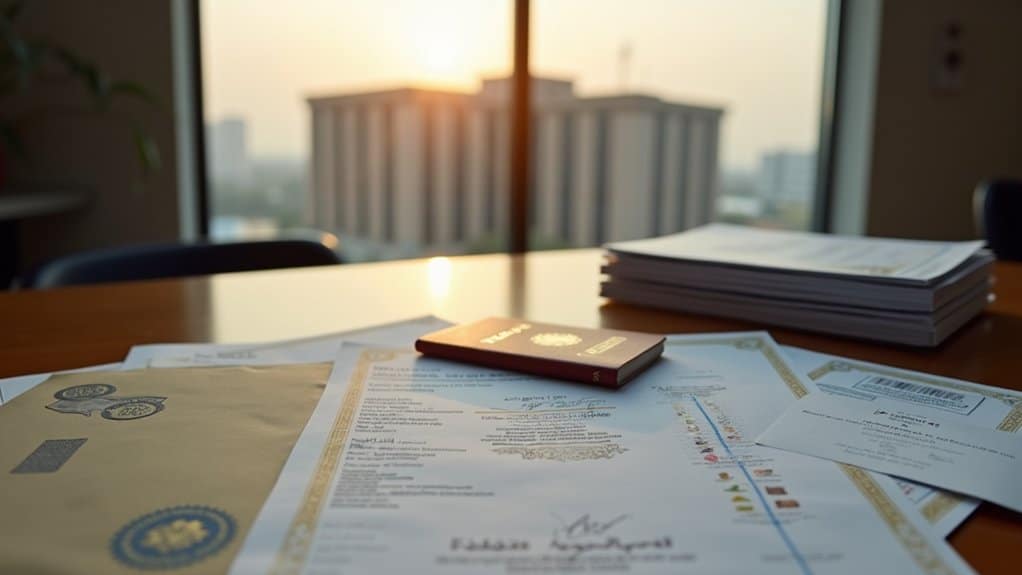
The embassy and MOFA attestation process usually follows a fixed order, issuing authority or notary, home-country Ministry of Foreign Affairs, destination Gulf embassy or consulate, and then MOFA in the destination country. You should follow that order exactly, because a missing seal can stop licensing intake. First, confirm whether you need originals or certified copies. Then submit each document to the issuing country’s MOFA for authentication of the local signature or seal. Next, apply through the destination Gulf embassy’s required portal or counter process, pay the fee, and arrange pickup, courier return, or appointment attendance. Finally, complete destination MOFA attestation, such as UAE MOFA courier or digital service, and check every stamp, reference number, and document category before submission.
How does certified translation fit into attestation
Certified translation sits after legalization in the attestation chain, especially when your degree, license, good standing certificate, or transcript isn’t in the language accepted by the Gulf licensing authority. First, complete the issuing authority, home MOFA, embassy, and destination MOFA seals required for that document. Then arrange a certified or sworn translation that reflects the attested text exactly.
Treat the translation as part of the submission bundle, not a substitute for authentication. Keep the original document, attestation stamps or digital proof, and translated copy together as one controlled set. Check the regulator’s checklist before filing, since English is common but not universal. If names, dates, seals, or titles don’t match, correct them before licensing review starts.
How do attestation steps and costs compare by stage

Compare each attestation stage by mapping the chain and pricing each action separately. You shouldn’t treat attestation as one fee, because every authority controls its own review, payment, and delivery method.
| Stage | Cost driver |
|---|---|
| Issuer/notary | Copies, seals, notarization |
| Home MOFA | Legalization fee, appointment rules |
| Gulf embassy | Mission fee, courier, originals |
| Destination MOFA | Digital or courier attestation |
| Translation | Certified language pair, formatting |
Use this breakdown to budget per document: degree, license, transcript, and good standing certificate. Confirm whether the destination accepts digital attestation or requires originals. Add courier charges, payment gateway fees, and urgent-processing premiums where allowed. Track receipts and reference numbers, because you’ll need them to prove completion before licensing submission.
How do you avoid common attestation mistakes
Avoid common attestation mistakes by building your file around the required chain before you pay any fee or send originals. Confirm the sequence: issuing authority or notary, home-country MOFA, destination embassy or consulate, then destination MOFA when required. Don’t translate too early; arrange certified translation after legalization if the licensing authority requires English or another accepted language.
Check every name, date, seal, signature, and document type against the regulator’s checklist. Select the correct MOFA service, destination country, and attestation category, especially for UAE digital or courier workflows. Don’t assume one Gulf route fits another; Qatar, Kuwait, and UAE rules differ. Keep scanned copies, receipts, courier tracking, and appointment confirmations. Submit originals only through approved channels, and resolve missing seals before licensing or DataFlow review starts.
Conclusion
Attestation is one of the most detail-heavy stages of Gulf licensing: home-country legalisation, embassy and MOFA seals, certified translations, and validity windows all have to line up in the right order. A single expired certificate or missing stamp can send the whole file back. Allocation Assist helps doctors sequence their attestation and translation steps correctly, so documents reach the regulator complete and acceptance is not lost to a paperwork technicality.
Call Today and Simplify Your License Process
From MOFA attestation to embassy verification, every documentation step matters for Gulf medical licensing. At Allocation Assist Middle East in Dubai, UAE, our experienced team delivers dependable Licensing Services shaped around a smooth, stress-free process. Call +971 4 273 3477 today and take the next step in your medical career.
Frequently Asked Questions
Can Attested Documents Expire Before My Gulf Medical License Is Issued?
Yes, they can. The licensing authority’s validity rules are worth checking before submission, because attestations often stay valid even when supporting documents do not. Good standing certificates, medical certificates, DataFlow reports, exam results, or translations may all carry time limits. Any expired item needs refreshing while keeping the legalisation chain intact. MOFA or embassy seals do not guarantee acceptance if the regulator applies a newer-date requirement.
Do Digital Attestations Carry the Same Acceptance as Physical Stamps?
They can, where the receiving Gulf authority recognises that format. Confirming this before submission matters, since acceptance depends on the regulator, document type, issuing platform, and destination country. UAE authorities increasingly accept verified digital attestations, but relying on one without checking the specific regulator’s stance risks a rejected file.
Can I Submit Licensing Documents While Attestation Is Still Pending?
Usually not, unless the authority expressly allows a provisional upload. Most Gulf routes require completed home-country legalisation, embassy attestation, and destination MOFA attestation before acceptance, so the regulator’s checklist governs. Where a portal does permit early submission, pending items should be labelled clearly, receipts uploaded, and deadlines tracked. Incomplete attestation can still trigger a rejection, hold, or resubmission request, so review is not guaranteed to proceed.
Are Notarized Copies Accepted Instead of Original Medical Documents?
Usually not, unless the licensing authority or embassy expressly allows them. Originals, or certified true copies where the checklist permits, are the safer submission. Where a copy is used, the full legalisation chain still applies: issuing authority or notary, home-country MOFA, and destination attestation. Assuming a notarised copy will substitute for an original is a common cause of delay.
Who Can Collect Attested Documents on My Behalf?
An authorised representative or courier can usually collect attested documents, provided the authority’s pickup rules are followed. That typically means an authorisation letter, an ID copy, the representative’s ID, the payment receipt, and the application reference. Some embassies or MOFA offices require original receipts or scheduled collection slots. With courier or digital attestation, personal collection is usually unnecessary unless the authority specifically requests it.