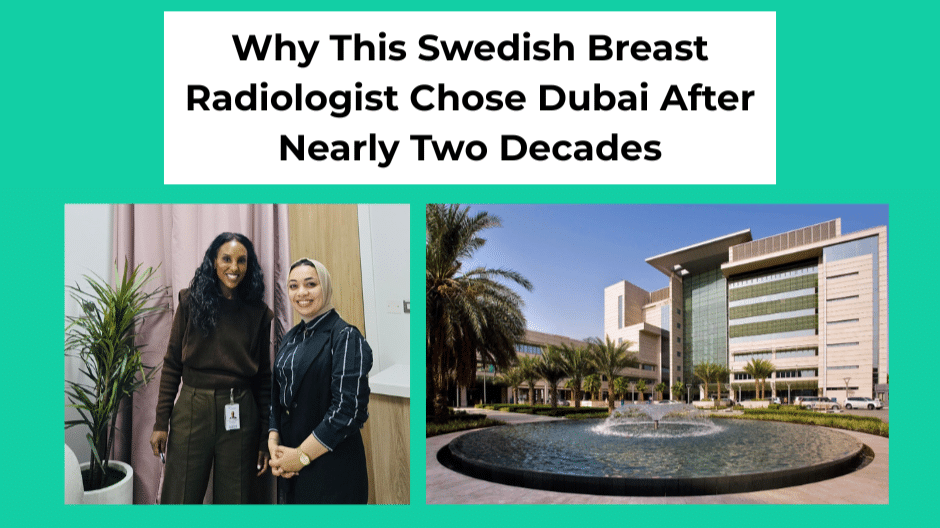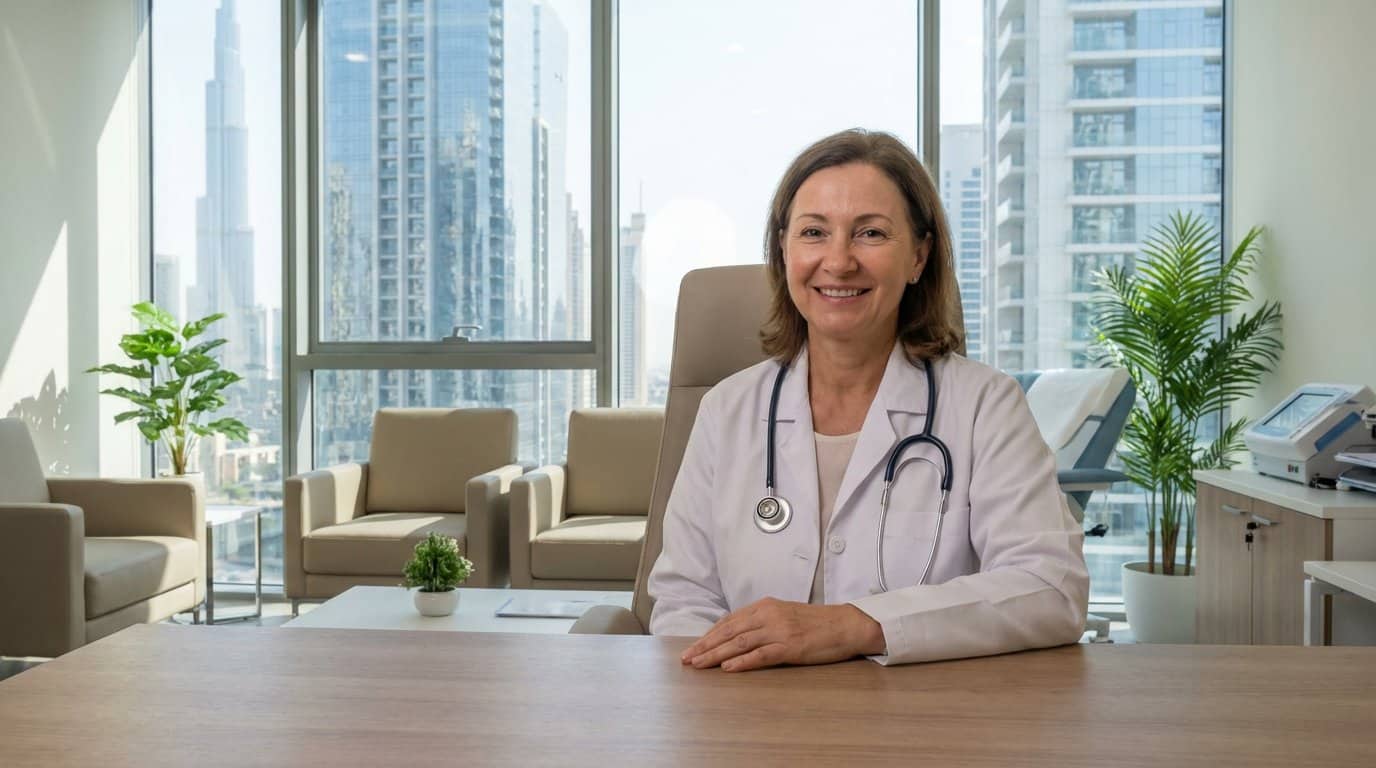
When Dr. Salina Berhane walked into American Hospital Dubai for her first day as a Consultant Breast Radiologist, she’d just relocated from Sweden with her husband and children, ages 3 to 12. Behind her was 17 years in Swedish medicine, the last seven spent exclusively in breast radiology. Most recently, she’d overseen seven breast centers screening 350,000 women annually. Four weeks in, she’s learned some things that surprised her about working in Dubai.
Why She Chose Dubai
Dr. Berhane graduated from medical school in Sweden in 2007 and built her career entirely within the Swedish healthcare system. For the past seven to eight years, she specialized exclusively in breast radiology, becoming an interventional breast radiologist before taking on leadership responsibilities at Unilabs.
In that role, she oversaw breast screening for 350,000 women annually and managed 80,000 clinical diagnostic mammograms across seven regional breast centers.
So why leave a senior position in one of the world’s most respected healthcare systems?
“We’ve been thinking about it for a long time because we come here a lot for vacation and we have relatives here,” Dr. Berhane explains.
“But the reason I thought now was a good time was, to be honest, the ages of my kids. My oldests are 12, and I thought the transition would be harder when they’re teenagers. I’ve always found Dubai to be very kid-friendly, and that was important.”
The decision came down to timing, family, and opportunity.
What She Found Different About Dubai Medicine
Dr. Berhane had done her research. She understood Dubai’s healthcare system would operate differently from Sweden’s model. She expected cultural adjustments and administrative differences.
What stood out most was the clinical flexibility.
“The availability of diagnostic pathways, the different modalities that we can offer women, how quick everything works here,” she notes.
“In Sweden, we would screen 350,000 women a year, so the volume was immense. Here, since it’s by referral, as a breast radiologist, I have more possibilities to diagnose the woman in the way that I want.”
Coming from a screening-based system where every woman aged 40 to 74 receives mammograms, the referral-based model in Dubai allows for more individualized diagnostic approaches. Each patient pathway can be tailored based on clinical presentation.
But she’s also quick to add perspective.
“To be totally honest, at the end of the day, it is the same. Medicine is the same everywhere. For anyone else coming, I think there will be small differences, as there would be if I worked in the northern part of Sweden or in Norway. But it’s not that big of a difference.”
The Practical Adjustments
Ask Dr. Berhane what genuinely surprised her, and she doesn’t mention medical protocols or hospital technology. She talks about language and rhythm.
“Since I’m coming from a non-English speaking country, preparing the reports in English is, even though I thought I spoke perfect English, what’s taking time for me,” she admits.
“In Sweden, it comes naturally. I can write it in my sleep. But here I have to weigh my words. However it’s already getting easier.”
Then there’s the work schedule. Sweden operates on a 40-hour work week, while Dubai typically runs 48 hours.
“It’s about an extra day of clinical time each week,” she notes.
“What makes the difference is the work itself. The time flies because it’s good work, and American Hospital has been a great place so far. Very, very pleased.”
By her third week, Dr. Berhane had adapted to the pace.
The Realities of Relocation: What to Actually Expect
Dr. Berhane had two major concerns before relocating: navigating a new city and language.
Getting around Dubai required adjustment.
“When they told me, okay, you’re gonna live here, work there, when you look at the map, the distances look short. But when I’m actually driving, it takes longer than I expected because of the traffic,” she explains. “Now I just plan accordingly and leave earlier. It’s become part of the routine.”
The language concern, however, turned out to be unnecessary.
“I was anxious about not speaking Arabic. I thought I could understand a bit, but when I came here, I realized I don’t understand. But everyone speaks English, and the patients are not like, ‘I prefer an Arabic speaker’. So far, it hasn’t been an issue at all.”
Finding the Right Fit
Dr. Berhane worked with Allocation Assist for her move to Dubai.
“They told me it was going to need six to eight months to find the position. And you’re a breast radiologist, so say eight months. Literally, on the eighth month, I had an interview,” she recalls.
What impressed her wasn’t speed but accuracy. I trusted their guidance. Because for me, I don’t know the hospitals here. To me, it’s just names. But really, with my profile, I feel like I came to the right place.
The hospital’s support for her relocation made the transition smoother. They provided family accommodation suited to her household size, assisted with visa processing for the entire family, and helped coordinate the practical aspects of an international move, including insurance arrangements. Annual travel support for the family was also part of the package, which matters when you have family ties back home.
The support extended beyond job placement to licensing, housing, and family logistics.
“Very helpful with everything. Not only with finding me a job, but also with everything around it. Very smooth.”
Her husband, also a physician, is currently in the licensing process with Allocation Assist as well.
Her Advice for Doctors Considering Dubai
When asked what she’d tell colleagues who are considering a similar move, Dr. Berhane’s answer is direct.
“I was going to say do the research, but then I realized someone did the research for me. If you come from a system like Sweden, so different from here, it’s hard to find a hospital that would suit you on your own. You don’t want to set back your career. And especially if you’re moving with a family and starting over here, having guidance makes a difference because when I get the referrals now, I realize it’s so big. There are so many different hospitals. It’s hard to know where to go.”
She adds a practical observation that many doctors miss.
“In Sweden, the healthcare landscape is more contained and easier to research. But here, since there are so many, I think it’s really hard to navigate on your own.”
One Month In
Four weeks into her new role, Dr. Berhane is settling into Dubai life.
“The kids still think they’re on vacation,” she laughs. They’ve visited Dubai many times before, so the city feels familiar. “Wait until they start school,” she adds. But for now, the family is adjusting well.
Her clinical work at American Hospital Dubai has met expectations. Breast radiology is fundamentally the same as what she practiced in Sweden, just delivered through a different system model. The diagnostic tools are excellent, the patient care is individualized, and the professional environment has been welcoming.
The work rhythm is different. Getting around takes planning. The adjustment to writing medical reports in English took a few weeks. But the core of what attracted her to Dubai has proven accurate: a safe, family-friendly environment with professional opportunities that allow for personalized patient care.
For Western-trained breast radiologists considering Dubai, Dr. Berhane’s transition offers a useful benchmark. Expect the medicine to be familiar, the lifestyle to be appealing, and the adjustment period to involve practical details you might not anticipate.
Most importantly, trust the process. When she was told it would take eight months to find the right position, it took eight months. When she was advised that American Hospital Dubai would suit her profile, she trusted that guidance.
One month into her new role, that trust appears to be well-placed.
About Dr. Salina Berhane
Dr. Salina Berhane is a Consultant Breast Radiologist at American Hospital Dubai. She completed her medical training in Sweden and specialized in interventional breast radiology, with leadership experience at Unilabs overseeing seven breast centers across Swedish regions. She relocated to Dubai with her family in late 2025.
Considering opportunities in Dubai or the wider Gulf region?
We’ve spent over a decade placing Western-trained doctors across the UAE, Saudi Arabia, and Qatar, and we understand what it takes to find positions that align with both your clinical expertise and your personal circumstances. If you’d like to explore what might be possible, reach out.
Frequently Asked Questions
Does Dubai Require Swedish-Trained Doctors to Pass Additional Medical Licensing Exams?
Yes, Swedish-trained doctors must complete Dubai’s licensing and credentialing process before practicing. This typically involves primary source verification, documentation review, and approval from the relevant health authority. Dr. Berhane completed these steps prior to starting her role, allowing for a smooth transition into clinical practice.
How Different Is Practicing Breast Radiology in Dubai Compared to Sweden?
The fundamentals of breast radiology remain the same, but the system structure differs. Sweden follows a high-volume, screening-based model, while Dubai operates on a referral-based system. This allows for more flexibility in diagnostic pathways and more individualized patient care.
What Practical Adjustments Do Swedish Doctors Face When Moving to Dubai?
Most adjustments are practical rather than clinical. These include writing reports in English instead of a native language, adapting to a longer work week (typically 48 hours), and managing day-to-day logistics such as commuting and traffic. These changes usually become routine within the first few weeks.
Is Language a Barrier for Swedish Physicians Working in Dubai?
English is widely used across Dubai’s healthcare system, so language is generally not a barrier. Physicians can work effectively without speaking Arabic, although adjusting to writing detailed clinical reports in English may take a short period of adaptation.
How Are Relocation and Family Logistics Managed for Physicians Moving to Dubai?
Relocation is often supported by employers. This can include housing arrangements, visa processing, insurance, and assistance with settling family members. While school placement isn’t prioritized by profession, structured support helps families transition smoothly.
How Long Does It Typically Take to Secure a Medical Position in Dubai?
Securing the right role can take several months. A typical timeline is around six to eight months, covering job matching, licensing, and relocation planning. This allows physicians to transition in a structured and well-prepared way.