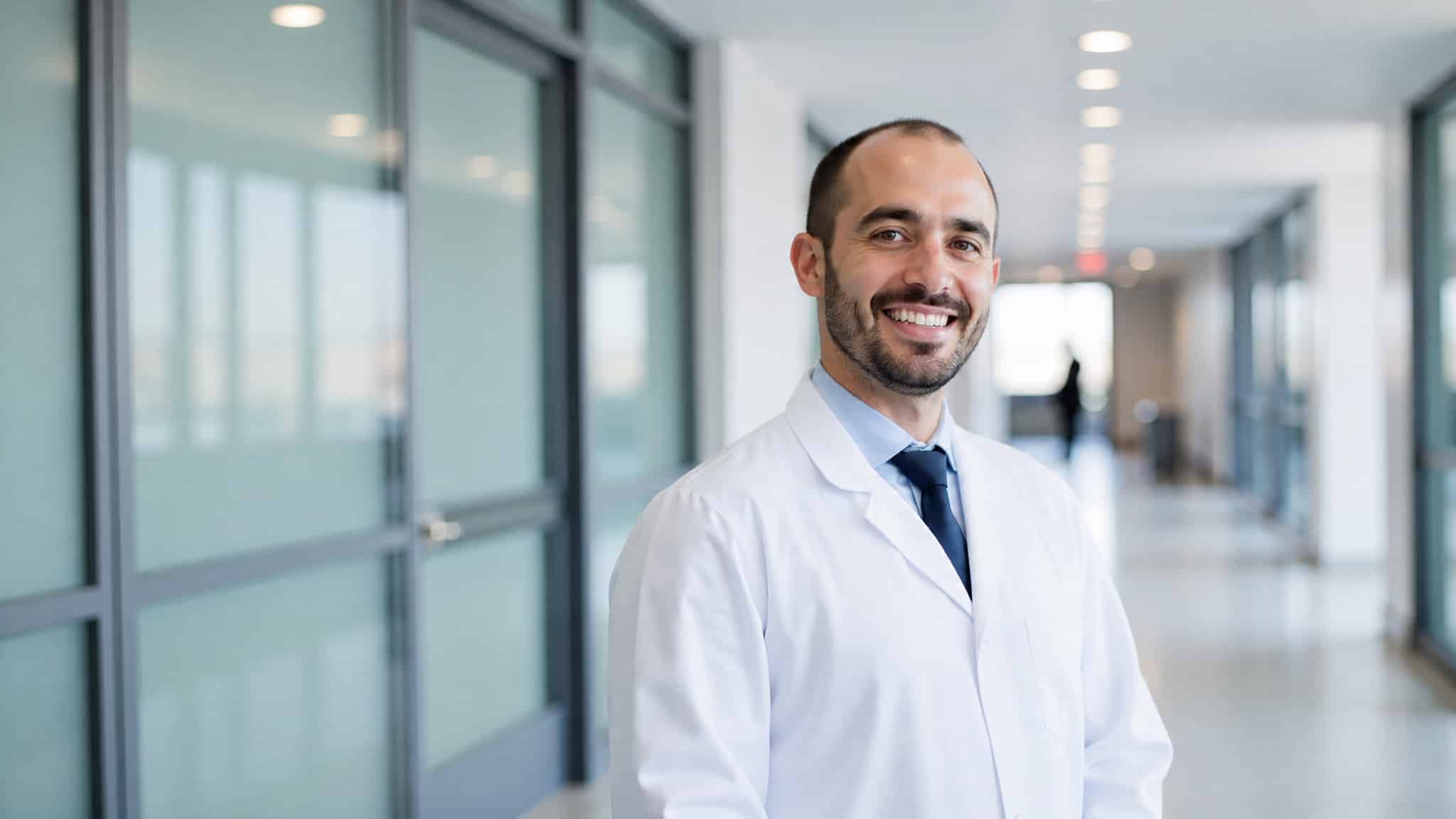
Dr Syed Farrukh Shah is a UK-trained Consultant Endocrinologist with over 18 years of international experience, who relocated to Dubai in August 2024. He graduated in Pakistan in 2006 and moved straight to the UK, where he completed his foundation training, core medical training, and specialty training in endocrinology, diabetes, and general internal medicine. After working as an NHS Consultant for nearly three years, he returned to Pakistan, where he served as a Consultant Endocrinologist and Medical Director at a not-for-profit healthcare organisation for around one and a half to two years. He now practises at NMC Specialty Hospital, Dubai, where he covers two NMC centres and shares his journey from the NHS to the UAE and the professional and personal rewards that have followed.
From Pakistan to the UK: A Career Built Across Three Healthcare Systems
Dr Syed Farrukh Shah’s career has spanned three very different healthcare environments. “I graduated back in 2006 in Pakistan, and straight after graduation I moved to the UK, where I started my foundation training. I did my core medical training, and finally I completed my specialty training in endocrinology, diabetes, and general internal medicine.”
After his training, he worked as an NHS Consultant for nearly three years, before going back to Pakistan for a different kind of role. “I worked there as a consultant for nearly three years, after which I moved to Pakistan. I was there for two years. I was working in a not-for-profit organisation as a consultant and medical director for nearly one and a half to two years.”
The UAE move followed soon after. “Last year I moved to Dubai, August 2024, and now I’ve been working as a consultant for nearly one and a half years.”
Why Dubai: A Long-Standing Curiosity Turned Reality
For Dr Shah, the move to Dubai was not the result of a single decision but a long-standing interest that grew over many years. “That’s a very interesting question, and to be honest, I don’t have a very straight answer for that. I can tell you a story just to explain why I don’t have a straight answer.”
He traces the earliest spark back to his school days. “I was in a boarding school basically, and once there was a debate. It was a humorous debate, and the topic of the debate was, you know, forget about studies and let’s go to Dubai. So there was argument for and against. Somehow I think I just picked up both arguments. I picked up, go to Dubai, but maybe after completing your studies and training. We are all made up of a combination of our lifetime experiences, basically.”
His first real look at the city came years later. “I visited Dubai for the first time in 2012 and I liked the city. It was a holiday, so when you are on holiday everything looks very nice.” Beyond that first impression, what continued to draw him to Dubai was the city’s sheer momentum. “The way the city has developed, the country has developed, it’s a very young country. It provides a lot of opportunities to grow, for entrepreneurship and jobs. There are a lot of things you can do differently when a place is developing like this. I think that was kind of the main motivation behind the move.”
NHS, Pakistan, and Dubai: Three Systems Compared
Having worked across the NHS, Pakistan, and now the UAE, Dr Shah has a useful comparative view of his current role. “I must say, over the last couple of years I have a very varied experience working in the NHS, then working in Pakistan, and now working in Dubai.”
He describes the NHS as a highly mature and structured system. “NHS is a very mature system. Everything is very streamlined. Things are done in a very predefined way. I feel like there is a lack of opportunities, maybe. It’s kind of a rigid way, so there is a lack of opportunities for people who want to do things differently.”
Dubai, by contrast, sits at the opposite end of the spectrum. “Dubai is very dynamic. It’s a very young country, it’s a very young system. It’s still going through changes. It’s looking at a lot of other systems to adapt. So there is a lot of growth, there is a lot of potential, and there is a lot of opportunities to do things quite differently.”
He sums up the contrast like this: “NHS is a very mature system, but it’s kind of at an old age, and Dubai is still very young and there’s a lot of growth potential in this system.”
A Diverse Patient Base at NMC
Dr Shah now covers two NMC centres as a Consultant Endocrinologist, and the patient mix is unlike anywhere he has worked before. “It’s very diverse. It’s like you are working in a couple of different countries at the same time. You will see one patient will be from the Philippines, one patient will be from India, another one will be from Pakistan. It’s a very diverse environment, very diverse culture.”
His own multilingual background turns out to be a significant clinical asset. “I come from the same diverse background. I speak Urdu, Hindi, Pashto, English. So that really helps a lot in this environment.”
And the variety, he says, is part of what keeps the work fresh. “It’s very exciting, because you don’t know who comes through the door. So going to work is always new. It never gets boring.”
The Realities of Relocation and the Role of Allocation Assist
Dr Shah is open about the fact that the move to Dubai wasn’t easy and took longer than he had hoped. “It has been challenging, of course. I had decided right after my CCT, which I completed in 2019, to move, and I moved here in 2024. So all those years I was trying. For the first two or three years I was trying, and to be honest, the market dynamic has changed. Dubai has become very competitive. For two or three years, I just couldn’t break into the job market, the healthcare sector.”
His route to NMC came through Allocation Assist after years of looking on his own. “I’m just fortunate that I was going through different profiles and hit Allocation Assist in one of those searches. I went through the profile, did my own research, contacted them, got connected with them, and they connected me to quite a few different hospitals. In the end, here is the outcome basically. I would say without the help of Allocation Assist, it would have been quite difficult to get into the job market without their help.”
Family Life in Dubai
The transition for Dr Shah’s family was made easier by Dubai itself, although the timing of the move tested them in one practical way. “When we relocated, it was August or September, so these are the hottest days of the year. Initially, they were getting used to the weather, but when the weather turned nice, they are very happy now.”
He says the bigger transition for the children went smoothly too. “I would put it in a way that I don’t see any difference, because they were very much settled. They had friends, they were happy in their schools in England, and now they have got friends, they are settled in their school, and they’re quite happy. For them, it’s a very easy transition, which the credit goes to Dubai. People can get adjusted very nicely.”
Advice for Consultants Considering the Move
From his own experience, Dr Shah offers a clear-eyed view to other consultants thinking about a similar move. “My advice would be that the job market here is quite tough. So you need the right connections. Connections, that’s the absolute minimum necessity to get into the UAE job market.”
He says this is where working with a specialist agency makes a real difference. “One of the reasons to get connected with Allocation Assist is that you get access to all those connections. One thing which is more important than the degrees, the qualifications, is the connections to break into the market.”
He is also realistic about the size of the change involved. “Obviously, one has to be prepared for going through a change. It’s not easy. It’s going to be a big change. One has to have done their homework and be prepared to face the challenge, because it’s not an easy transition for most people, I would say.”
Asked whether he is happy with the move, his answer is straightforward. “I’m quite happy with my decision. Obviously when you start somewhere new, you always have your doubts. But Dubai is an amazing place. You get adjusted to the environment very, very quickly. The work ethics, the work environment is a bit different, but that’s how things are usually when you start in any new place. The answer to whether I made the right decision, I would say, yes, absolutely.”
How Allocation Assist Supports Doctors Moving to the Gulf
As a healthcare jobs consultancy in Dubai, our team has been placing Western-trained doctors in Gulf region hospitals for over 11 years, with relationships at 95+ hospitals across the UAE, Saudi Arabia, and Qatar.
Key Areas of Support
- Hospital matching, based on your subspecialty, case mix, and family priorities.
- DHA, DOH, MOHAP, and SCFHS licensing, including multi-specialty credentialing.
- Contract review and negotiation, including salary, package, and insurance terms.
- Relocation and family logistics, including schooling, housing, and post-arrival support.
- Ongoing peer community, connecting you with doctors who have made the same move.
For hands-on help with your move, explore our DHA license consultancy. To talk through your own move, you can book a free consultation.
Frequently Asked Questions
What is Dr Syed Farrukh Shah’s background and qualifications?
Dr Shah is a UK trained Consultant Endocrinologist with over 18 years of international experience. He graduated in Pakistan in 2006 and completed his foundation training, core medical training, and specialty training in endocrinology, diabetes, and general internal medicine in the UK. He worked as an NHS Consultant for nearly three years, then served as a Consultant Endocrinologist and Medical Director at a not-for-profit healthcare organisation in Pakistan, before relocating to Dubai.
Where does Dr Shah work in the UAE?
He works at NMC Specialty Hospital, Dubai, and covers two NMC centres as a Consultant Endocrinologist.
Why did Dr Shah relocate to Dubai?
He was drawn by Dubai’s dynamism, growth, and opportunities for doing things differently. As a young, rapidly developing healthcare system, he saw it as a place where consultants could shape practice in ways that more established systems often do not allow.
How does Dubai compare to the NHS and Pakistan?
He describes the NHS as a mature, highly streamlined system with predefined ways of working, but limited room for clinicians who want to innovate. Dubai, by contrast, is a young system going through rapid evolution, with significant growth potential and flexibility for consultants to develop new ways of practising.
What is his patient base like at NMC?
His patient base is highly diverse, with patients from countries including the Philippines, India, Pakistan, and across the wider region. His multilingual background, including Urdu, Hindi, Pashto, and English, plays an important role in providing culturally and linguistically appropriate care.
How long did it take Dr Shah to relocate, and how did Allocation Assist help?
Dr Shah completed his CCT in 2019 and finally relocated in 2024, having spent several years trying to break into a highly competitive UAE job market. He credits Allocation Assist with making the move possible, saying that without their help it would have been quite difficult to get into the job market.
How has his family found the move?
His family have settled in well, with his children happy in their schools and forming new friendships. He describes the transition as very smooth, crediting Dubai itself for making it easy for newcomers to adjust.
What advice does Dr Shah give to consultants considering the move?
His main point is that connections matter in the UAE job market, often more than degrees and qualifications alone. He encourages consultants to do their homework, be prepared for a significant change, and to work with a trusted partner to access the right opportunities. Reflecting on his own experience, he is unequivocal that he made the right decision.