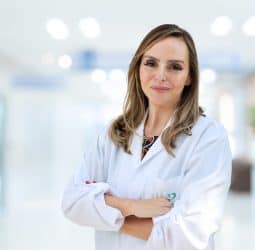
In this exclusive interview, Emilie speaks with Dr. Rachel Kaminski, a consultant pulmonologist with over two decades of experience in the UK’s National Health Service (NHS) and now practicing in Dubai at Saudi German Hospital. Rachel shares her inspiring journey into medicine, the motivations behind her specialization in pulmonology, her decision to relocate, and her reflections on practicing medicine in the UAE. She also discusses her academic contributions, family life, and advice for other doctors considering international relocation.
So good to see you Rachel, thank you so much for your time today. To start off, could you give us a brief overview of yourself, including your training, professional experience, and your current role?
Oh Emilie, I’ve been looking forward to doing this interview with you for so long and I’m pleased that we’re finally doing it. So my name is Rachel Kaminski, I am a consultant pulmonologist and I’ve been working here in Dubai now for two years. I work at a Saudi German hospital. Originally I’m from the United Kingdom where I did all my training, went to medical school there at Imperial College and then did 19 years in the NHS before coming here.
So what motivated you to choose medicine and particularly focus on pulmonology?
As a little girl, I dreamed of becoming an actress. That changed one evening while attending a concert where my brother was performing on the piano. As we sat in the audience, my father suffered a massive heart attack and had to be airlifted to the hospital. We were left at the school, and I remember everyone trying to explain to me, a 10-year-old girl, what was happening and who was going to help him. The only way I could cope, make sense of it, and get through the situation was by knowing exactly what was happening. The very next day, I went to the hospital, eager to understand what they were doing and how they were helping him recover. I instantly developed deep admiration for the doctors who were able to give me my dad back, and I became fascinated by the human body and its incredible intricacy.
You might think I would have become a cardiologist, but what stayed with me most was the memory of my dad struggling to breathe. Witnessing that, and realizing the difference one could make in such moments, inspired me to become a lung specialist. I love that in this field I can care for both acute and chronic conditions, treat patients young and old, and work within a specialty that I truly believe is the best and the people that are pulmonologists are just wonderful.
That’s one of the most inspiring things I’ll always remember about you. In fact, when I first met you, shortly after you moved to Dubai, I attended one of your presentations, and listening to you speak truly inspired me. You said something along the lines of, “What better way to make a difference and be of service in life than by helping people breathe?”, and when I heard that, I was completely blown away. So, what made you decide to relocate, and why did you choose Dubai in particular?
I truly love being a doctor, and I was very happy in the UK. I had an amazing team, I was established as a consultant, and we had come through the challenges of Covid together. But there was always something nagging at me. Each winter, the quality of care I was able to provide seemed to decline under the immense pressure on the NHS. No matter how hard I worked, it never felt like enough. I would come home each day thinking, if only I could have done more. Patients were left waiting in ambulances, unable to even make it inside, and that was incredibly hard to accept. Then I began talking to others about new challenges and opportunities that might be more fulfilling.
That’s when I heard about Dubai, how it was emerging as a global epicenter for healthcare, attracting specialists from around the world, building incredible medical hubs, and using technologies we could only dream of. Then I considered my specialty and the gaps in healthcare here in the Middle East, such as asthma management, patient understanding of chronic diseases, long-term medication adherence, and the new era of specialist treatments, it just felt like the right place to make a difference. Then I met a doctor who suggested I speak with you, and even before my journey here began, you were so open and approachable. I could ask you about what life in Dubai was really like, the challenges, the opportunities, and that helped me form a clear picture without any pressure. That’s when I knew I was fully committed, and you recognized it. I asked for your help in finding the right job and relocating my family, and you worked tirelessly to make it happen. I’ll never be able to thank you enough for that.
Has your practice changed in any way since you started working here?
Many people say that, but I was trained very much in the NHS system, attending a British medical school and spending 19 years in the NHS. For me, everything is evidence-based, guided by protocols and guidelines. Some of my patients find it challenging when I don’t automatically prescribe nebulisers or antibiotics, and I have to carefully justify every decision to say yes. You may need antibiotics, a nebuliser, steroids, or even hospital admission, because that’s the kind of medicine I trust: the approach I was trained in, guided by current evidence, best practices, and up-to-date guidelines.
It’s easier to provide quality care here because patients can see you before they’ve suffered the consequences of delayed or inappropriate treatment. This allows you to intervene earlier, truly change lives, and make a meaningful difference. I don’t encounter the really severe, complicated cases of pneumonia because patients here can access proper treatment early. Many of my patients with severe asthma in the UK would have been on long-term steroids for years, which often caused side effects like depression, anxiety, and weight gain. Here, not a single patient is on long-term steroids because they have access to proper care, a strong referral system, and the right treatment options. So that is different, so we’re not seeing more end organ damage, we’re being able to intervene much more readily and also, I have an excellent cardiologist just two doors away and a rheumatologist a couple of corridors down, so if something comes up outside my specialty, I can easily reach out, and they can see the patient, which is fantastic.
This has actually been a recurring theme today, other doctors I’ve spoken with have also noted how their practice has improved here, thanks to the advanced facilities and access to the latest technology and equipment.
Well, We’ve actually been among the first countries to launch new treatments, sometimes even ahead of the US and the UK. If I think about some of the medications that have been launched here, particularly in my field of airways, we were the second or third country worldwide to introduce certain medications which says a lot. This shows the level of trust, the infrastructure, and the ability to deliver the right treatment to the right patients at the right time to make a real difference.I believe it starts at the top, with how Dubai’s healthcare system is structured, from the governing bodies and legislation to hospitals acting as early adopters, to patients and doctors seeking higher standards. With all payers aligned and striving for the same outcomes, that’s why the system works so effectively.
Do you have any future plans, ventures, or projects that you’re considering and would like to share?
So there’s quite a few things that I’m doing, I’m very much involved in academia research, setting up research trials, being involved in publications, collaborating on data. We are all working together, we’ve got an amazing network of pulmonologists across the United Arab Emirates. I want us to get all our data together. We have an amazing society, the Emirates Thoracic Society, where I’m now heavily involved as part of the airways team. Our focus is on supporting and upskilling primary care providers. So there’s lots of projects that I’m involved in with some amazing people that are making big differences to patients. We’re introducing many new treatments and working to establish Saudi German as an official centre of excellence for asthma and COPD. We’ve already had publications, I’ve had about four or five since I’ve been here, so now moving on and aiming for even bigger publications, even more research, so it’s exciting.
That’s incredible, four or five publications since you’ve been here, all while working long hours and you’ve got a family. How do you manage to do it all?
I have a lot of support from my family, I have a very supportive husband who really takes the load with the family and the kids. I’m fortunate to have incredibly supportive colleagues at work, as well as friends in the pharmaceutical industry who help with projects I initiate. Many people who come here share the same mindset, they’re ambitious, have a vision, and are striving to better themselves and their families. Surrounding yourself with people who are all moving in the same direction creates an environment where everyone motivates and pushes each other. When you have an idea, there’s often someone ready to run with it, allowing you to focus on your expertise while the infrastructure supports you. That’s why so much can be achieved here, because there are so many people willing to put in the time and effort, all as committed as you are.
You’re just an incredible leader.
Thank you.
How’s your children enjoying the schools here?
The schools here are brilliant, they can do so many activities that are amazing, they’re learning to code, they’re learning about AI. My daughter’s super sporty and she won the under 11 rugby player of the school. She’s only 11 and she’s also a runner. My son’s a little mathematician. The schooling here is brilliant, and what I love is how my kids’ school, King’s, focuses on each child’s strengths, offering extra lessons in the areas they excel at. That’s how real life works, not everyone is strong in English or Maths, so nurturing their talents is exactly what should be done. It’s wonderful because it helps them feel confident and positive about themselves.
Dubai’s got everything, I know it’s hot at the moment and the holidays are long, but you know, the kids are going to sports camp. They’re learning badminton and jiu-jitsu, they swim every day and the dog here is happy, she’s in the pool every day. So you can make life here, life here is very easy. Back in the UK, I struggled with long hours, both my husband and I worked tirelessly, and by the end of the day, we could just manage to pay the mortgage and bills, take one family holiday a year, and still couldn’t afford private schooling for our kids. Here, although we still work hard, we’re able to provide the best for our family, enjoy amazing holidays, and save money. We also have the support and infrastructure to outsource tasks that normally take up my time, like laundry, ironing, dishes, and house cleaning, so I can focus on more important things. So that when I get home, because I get home at 6.30, I can then just be mummy for two hours. So my kids actually get more of me here, they get much more of me than they did in the UK.
Do you have any advice that you could give to other doctors that might be considering a relocation to the region?
It’s amazing and brave of you to think about upsetting the status quo and doing something different, but life’s meant to be lived. The fact that you’re thinking about it says a lot. Speak to people, ask questions, there’s no silly questions. I’m happy to speak to you, ask you lots of questions, because the more information you get, you’ll know whether something is the right fit or not. I was really lucky that my old trust actually gave me a two-year sabbatical in order for me to come here. I think many countries are now struggling to retain their doctors, so coming here is almost a risk-free opportunity. You can try it out, see if it suits you, and if it does, fully commit. I unfortunately said to my old trust, I love it here, I’m staying and I’m not coming back. And they said, we thought you’d say that, but we hoped, so that’s why we did it. There are ways to protect yourself. You can rent cars or get a six-month lease, do things temporarily, and later, if you decide to make it permanent, that’s also straightforward. Everything here is very easy and often managed over WhatsApp. It might sound crazy, but we even bought our house through WhatsApp, that’s just how things are done here.
How has your experience been working with Allocation Assist?
You still care about every single doctor that you’ve placed here. Even now, there’s no need for you to invest further. You’ve got us here, but you genuinely care and you continue to check in and show real concern. You know, everyone always talks about you so highly and has their story with you. You vet hospitals, you check them. And if you don’t think they’re right, you don’t put people there. You have lots of integrity. And I think you are doing a fantastic job, not only for the hospitals here, but also for the doctors. And I trust you and can recommend you 1 million percent as a company.
Thank you so much.