You’ll experience a fundamentally different healthcare milieu in Dubai compared to Europe’s public systems. Tax-free salaries boost your take-home pay by 40-45%, while housing allowances add another 20-40% on top. You’re working in a private-sector-dominated environment where over 90% of colleagues are expatriates and patients arrive from dozens of nationalities. The trade-offs involve complete DHA re-credentialing and maneuvering cultural communication differences that shape your daily practice.
Dubai vs. Europe: What Matters Most for Practicing Doctors
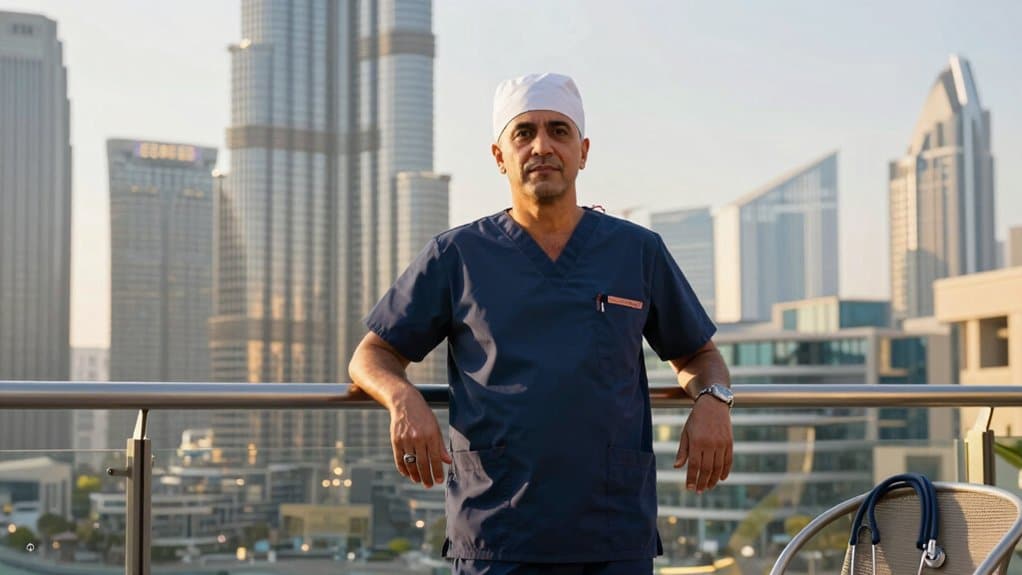
When you’re weighing a move from Europe to Dubai, the differences extend far beyond geography, they reshape how you’ll practice, earn, and live.
Practicing medicine in Dubai vs Europe reveals stark contrasts in compensation structure. Your tax-free salary delivers 40-45% more take-home pay than UK equivalents, with consultants earning AED 60,000-90,000+ monthly. Housing allowances add 20-40% to your base pay, benefits rarely matched in European systems.
The healthcare differences UAE Europe present involve workflow philosophy. Private healthcare Dubai physicians work within business-oriented decision-making frameworks, unlike standardized public systems. You’ll see 25-30 patients daily with dedicated follow-up time, contrasting NHS corridor treatments. Before making the move, NHS doctors and nurses must obtain a local UAE licence to practice in the emirate.
Patient demographics demand adaptability, Dubai’s international population requires flexible communication approaches you wouldn’t encounter in homogeneous European practices. Education allowances covering international school fees for 2-3 children deliver cost savings exceeding $15,000-$30,000 annually, making family relocation financially viable in ways European positions simply cannot match.
Licensing and Credentials: DHA Requirements for Foreign Physicians
Three distinct verification layers separate you from practicing medicine in Dubai, and each demands meticulous preparation that European licensing boards rarely require.
First, you’ll navigate DHA’s mandatory registration through the Sheryan portal, submitting attested credentials from your home country, UAE Embassy, and Dubai’s Ministry of Foreign Affairs. Unlike streamlined EU mutual recognition agreements, DataFlow Primary Source Verification independently authenticates every document, your degree, transcripts, and postgraduate certificates undergo rigorous third-party scrutiny. This verification process typically takes 30-45 days to complete before you can proceed further.
Dubai’s DataFlow verification scrutinizes every credential independently, far more rigorous than European mutual recognition systems.
For European doctors adapting Dubai’s system, examination requirements vary considerably. UK-trained physicians need PLAB certification, while others may face DHA Prometric exams. Your Good Standing Certificate must be issued within six months, covering disciplinary history. Newly qualified doctors often find these assessments particularly demanding, as they include testing on local healthcare law, patient consent protocols, and telemedicine guidelines specific to Dubai.
Medical practice UAE expats find particularly challenging: licenses from other Gulf states don’t transfer. DHA operates as an independent authority, requiring complete re-credentialing regardless of regional experience.
Patient Loads and Staffing Ratios Compared

When you move from European practice to Dubai, you’ll immediately notice distinct differences in doctor-to-patient ratios, with Abu Dhabi projecting a need for 3,500 additional doctors by 2025 to meet growing demand. You’ll also work alongside colleagues from dozens of countries, creating multicultural staffing dynamics that require cultural competence and flexible communication styles. Dubai’s private sector average length of stay of just 2.6 days, compared to longer European benchmarks, means you’ll manage faster patient turnover and more intensive discharge planning. The private sector’s dominance is evident, with 73% of outpatients and 83% of inpatients treated in private facilities in 2022, meaning most physicians will find employment opportunities outside the public healthcare system. The Department of Health, Abu Dhabi has launched Open Data Dashboards that allow physicians and healthcare planners to access real-time health statistics and compare performance against international benchmarks.
Doctor-to-Patient Ratios
Although Dubai’s doctor-to-population ratio of 2.9 physicians per 1,000 residents surpasses the UK (2.8), US (2.5), and Canada (2.5), these numbers don’t tell the complete story of your daily workload. Although Dubai’s doctor-to-population ratio of 2.9 physicians per 1,000 residents surpasses the UK (2.8), US (2.5), and Canada (2.5), these numbers don’t tell the complete story of your daily workload, especially when factoring in the cost of living in Dubai USD and how it impacts overall financial outcomes.
| Region | Doctors per 1,000 |
|---|---|
| Dubai | 2.9 |
| UK | 2.8 |
| US | 2.5 |
| Canada | 2.5 |
| WHO Average | 1.72 |
Dubai’s private sector handled 7.8 million visits in 2017, while government facilities managed 1.4 million. You’ll find patient distribution differs noticeably from Europe’s public-heavy systems.
Despite favorable ratios, Dubai projects needing 8,300 additional physicians by 2025. This demand reflects population growth and expanding healthcare infrastructure. Your workload depends largely on whether you’re practicing in private or government settings, with private facilities typically processing higher patient volumes. The physician workforce has grown rapidly, with licensed doctors in Dubai reaching 8,700 in 2017, representing an 82.4% increase from 2010. Government data tracking physician density shows this ratio has been monitored since 2012, providing valuable insight into healthcare workforce trends.
Multicultural Staffing Dynamics
Because over 90% of the UAE’s healthcare workforce consists of expatriate professionals, you’ll work alongside colleagues from dozens of countries rather than the more homogeneous teams common in many European hospitals. Only 1.2% of UAE nurses are Emirati citizens, meaning your daily interactions span multiple languages, clinical training backgrounds, and cultural approaches to patient care.
Dubai Healthcare City alone houses over 160 clinical partners requiring diverse international talent pools. You’ll need strong cross-cultural communication skills that European settings may not have demanded. Medical tourism’s 630,000 visits in 2024 amplifies this multicultural environment, as facilities actively recruit multilingual staff. This demand intensifies as Dubai welcomed over 337,000 health tourists in 2018 alone, generating AED 1.2 billion in revenue.
Unlike Europe’s more standardized workforce pipelines, you’ll encounter AI-driven recruitment platforms and digital onboarding systems designed to integrate international professionals quickly into UAE practice standards. This technological approach supports a healthcare staffing market projected to reach USD 343.06 million by 2033, reflecting the sector’s rapid expansion and investment in workforce solutions.
Shorter Hospital Stays
Despite Dubai’s reputation for efficiency-driven healthcare, the data reveals a more complex picture than European doctors might expect. You’ll encounter substantial variation in hospitalization lengths depending on patient acuity and complications.
| Metric | Dubai Data | Typical European Range |
|---|---|---|
| Median Hospital Stay | 19 days | 5-7 days |
| Median ICU Duration | 14 days | 7-10 days |
| Median Ventilator Days | 11 days | 6-8 days |
These figures challenge assumptions about rapid patient turnover. You should understand that mandatory isolation protocols extending 10-14 days post-negative PCR considerably inflate stay durations. Hospital-acquired infections account for 17% of prolonged cases, while ARDS contributes another 15%. Additionally, myopathy and neuropathy contributed to 14% of extended hospitalizations, adding another layer of complexity to discharge planning.
For low-risk patients without comorbidities, you’ll see predicted stays as short as 2.77 days, aligning more closely with European efficiency standards. The patient population studied was predominantly male at 90.6%, which may reflect the demographic composition of the expatriate workforce in Dubai.
Medical Technology in Dubai’s JCI-Certified Hospitals
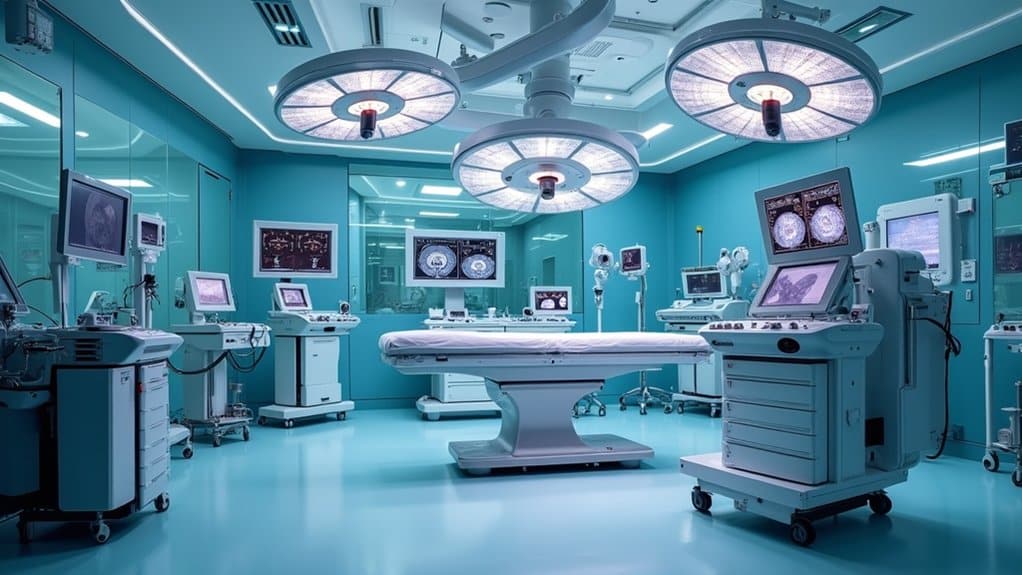
When you step into a JCI-certified Dubai hospital, you’ll encounter AI-driven diagnostic systems like IBM’s stroke imaging tools that deliver faster, more accurate assessments than many European facilities currently offer. Robotic surgical platforms, including the RAMS system and technologies that enabled the Middle East’s first robotic-assisted knee replacement at Mediclinic in 2018, give you precision capabilities that remain uncommon in standard European public hospitals. The integration of wearable technologies provides real-time patient monitoring that enhances continuous care delivery. You’ll also find blockchain-secured medical records integrated with advanced data analytics, creating a technological infrastructure that often surpasses what you’ve experienced in Europe’s more traditionally structured healthcare systems. Advanced imaging capabilities including PET/CT, SPECT CT, and 3T MRI provide comprehensive diagnostic options that support precise treatment planning across multiple specialties.
AI-Driven Diagnostic Systems
Dubai’s JCI-certified hospitals have integrated AI-driven diagnostic systems at a pace that often surpasses implementation timelines in European healthcare settings. You’ll encounter platforms like Ozelle’s AI-powered blood morphology analyzers, which process over 50 million daily cell images and deliver real-time risk stratification alongside conversational report interpretation.
Unlike Europe’s often fragmented adoption, Dubai’s healthcare infrastructure embraces unified AI pathways. Siemens Healthineers’ photon-counting CT and AI-assisted MRI systems operate within streamlined workflows designed for speed and precision. You’ll find scenario-ready AI panels for diabetes, cardiac monitoring, and even malaria screening, tools that extend diagnostic intelligence beyond routine testing. These systems have been validated through 50,000+ global installations, generating over 100 billion real-world data points that ensure lab-grade performance across diverse clinical settings.
The UAE’s national commitment targets 50% reductions in patient wait times through AI-driven triage and predictive analytics. This systematic integration means you’ll adapt to technology-forward clinical environments where AI augments rather than replaces your expertise.
Robotic Surgical Precision
Robotic surgical platforms in Dubai’s JCI-certified hospitals have achieved remarkable procedural volumes, American Hospital Dubai alone has conducted over 1,800 robotic surgeries since 2020, while Clemenceau Medical Center reports a 99.5% success rate across more than 1,000 robotic knee replacements.
You’ll find these systems deliver precision that reduces error margins to nearly zero compared to 20% in traditional methods. The second-generation CORI system, which the UAE adopted as only the second country after the US, achieves prosthetic fitting accuracy comparable to dental implants.
Clinical outcomes reflect this precision: blood loss drops by over 90%, and hospital stays shrink from two weeks to under three days. If you’re shifting from European practice, you’ll encounter surgeons controlling robotic arms through high-definition 3D visualization that transforms complex procedures into minimally invasive interventions.
Blockchain Medical Records
Beyond surgical precision, Dubai’s JCI-certified hospitals have embraced blockchain technology to transform how they store and share medical records, a shift that’ll reshape your daily clinical workflow if you’re migrating from European practice.
You’ll find decentralized storage distributes patient data across networks, reducing hacking vulnerabilities common in Europe’s centralized systems. The immutable ledger prevents tampering, ensuring data integrity that traditional European databases often lack.
Through Nabidh HIE, you can access seamless EMR sharing across Dubai’s public and private facilities, a stark contrast to Europe’s fragmented, cross-border limitations. MoHAP’s blockchain platform integrates licensed health facilities, while Emirates Health Services uses this technology for efficient record management.
You’ll also notice fraud reduction through algorithmic audits that eliminate duplicate claims, streamlining billing processes beyond Europe’s audit-dependent methods.
Inside Dubai’s Multicultural Medical Teams
With over 58,000 healthcare professionals registered in 2023, up from roughly 39,500 in 2019, Dubai’s medical workforce represents one of the most internationally diverse clinical environments you’ll encounter anywhere. You’ll collaborate with colleagues from across continents, serving patient populations that are 37% Asian, 31% Arab/GCC, and 15% European.
This diversity demands strong cross-cultural communication skills. Unlike relatively homogeneous European teams, you’ll navigate varying clinical approaches and professional expectations daily. The challenge is real, 66% of GCC healthcare professionals report stress or burnout, partly attributed to multicultural team dynamics.
Dubai actively supports integration through initiatives like streamlined Golden Visa processing for doctors and collaborative workspaces in the Dubai Healthcare City. You’ll find networking opportunities that don’t exist in siloed European systems, but intraprofessional collaboration requires deliberate effort and cultural adaptability.
Salary and Benefits: Dubai vs. European Compensation
Cultural diversity shapes your daily experience, but compensation ultimately determines whether Dubai makes financial sense.
Dubai’s tax-free salaries create substantial financial advantages over European equivalents. General practitioners earn AED 25,000, 50,000 monthly, while specialists command AED 40,000, 80,000. Compare this to France, Italy, or Spain, where GPs earn under $100,000 annually, then lose significant portions to income tax.
Dubai’s tax-free physician salaries deliver take-home pay that European counterparts simply cannot match after taxation.
Consider these Dubai compensation advantages:
- You’ll keep 100% of your earnings with zero income tax
- You’ll receive housing allowances and private health insurance beyond base salary
- You’ll earn a 15, 25% premium for Western training credentials
European specialists in Luxembourg or Denmark earn competitive gross salaries, but taxation reduces take-home pay considerably. Dubai’s private sector packages deliver superior net compensation, making the financial case compelling for doctors prioritizing wealth-building.
Cost of Living and Lifestyle Trade-Offs in Dubai
Tax-free salaries look impressive on paper, but Dubai’s cost of living absorbs a significant portion of those earnings. You’ll spend AED 5,500, 10,000 monthly on housing alone, compared to subsidized options some European systems offer. Groceries run AED 800, 1,200 for singles, while utilities add another AED 500, 1,000.
If you’re relocating with family, expect monthly expenses of AED 20,000, 25,000 for comfortable living. School fees represent a significant budget shock that European public education doesn’t prepare you for. Healthcare premiums range from AED 550 for basic coverage to AED 15,000 annually for extensive plans.
Transportation costs vary widely, AED 300, 800 monthly for singles using public transit versus AED 1,500, 3,000 for car-dependent families. These trade-offs require careful calculation before assuming Dubai’s higher salaries translate to greater savings.
Thinking About a Move to the Middle East?
At Allocation Assist, we match your expertise with the right opportunity and support your family’s transition from start to finish. We’ve helped hundreds of Western-trained doctors build meaningful careers across UAE, Saudi Arabia, and Qatar.
Frequently Asked Questions
Can European Doctors Maintain Their Home Country Medical License While Working in Dubai?
Yes, you can maintain your home country medical license while working in Dubai. The DHA doesn’t require you to relinquish your European credentials, they’re separate regulatory systems. You’ll need to keep your home registration active independently, following your country’s renewal requirements. Many doctors hold multiple licenses across jurisdictions for flexibility. Your European qualifications actually support your Dubai application through DataFlow verification, confirming your credentials without invalidating them.
How Does Malpractice Insurance and Legal Liability Differ Between Dubai and Europe?
In Dubai, you’ll find malpractice insurance is mandatory under Federal Decree-Law No. 4 of 2016, whereas many European countries operate voluntary systems. Before your case reaches court, Dubai’s Medical Liability Committees must review it, a pre-litigation step that doesn’t exist in most European frameworks. You can also expect higher premium costs in Dubai due to rising claims, and third parties can file claims directly against your insurer.
Are European Medical Specialization Certificates Automatically Recognized by Dubai Health Authorities?
No, your European medical specialization certificates aren’t automatically recognized by Dubai Health Authority. You’ll need to check the DHA Professional Qualification Requirements list, which only approves specific certificates from select jurisdictions. If you’re from Tier 1 countries like France, Denmark, or Luxembourg with approved credentials, you won’t need an exam. However, most European graduates must complete the Prometric CBT exam and undergo primary source verification through DataFlow.
What Language Proficiency Requirements Exist for Non-Arabic Speaking European Physicians?
You don’t need Arabic proficiency for DHA licensing. English serves as the primary language, you’ll take the Prometric exam in English, submit documents in English or Arabic translation, and conduct oral assessments in English. Unlike some European countries requiring local language fluency, Dubai’s multicultural healthcare environment operates chiefly in English. However, you’ll find basic Arabic phrases helpful for patient rapport, though they’re not mandatory for your professional credentials.
How Do On-Call Duties and Emergency Shift Expectations Compare to European Hospitals?
Dubai’s emergency departments require 24/7 staffing with mandatory ACLS, PALS, and ATLS certifications, requirements you’ll find similarly rigorous in European systems. You’ll work within UAE’s 48-hour weekly limit, though on-call classification varies by facility. Unlike many European public hospitals with standardized rotas, Dubai’s private sector may offer more flexible but commercially driven scheduling. You should clarify on-call expectations during contract negotiations, as practices differ vastly between employers.