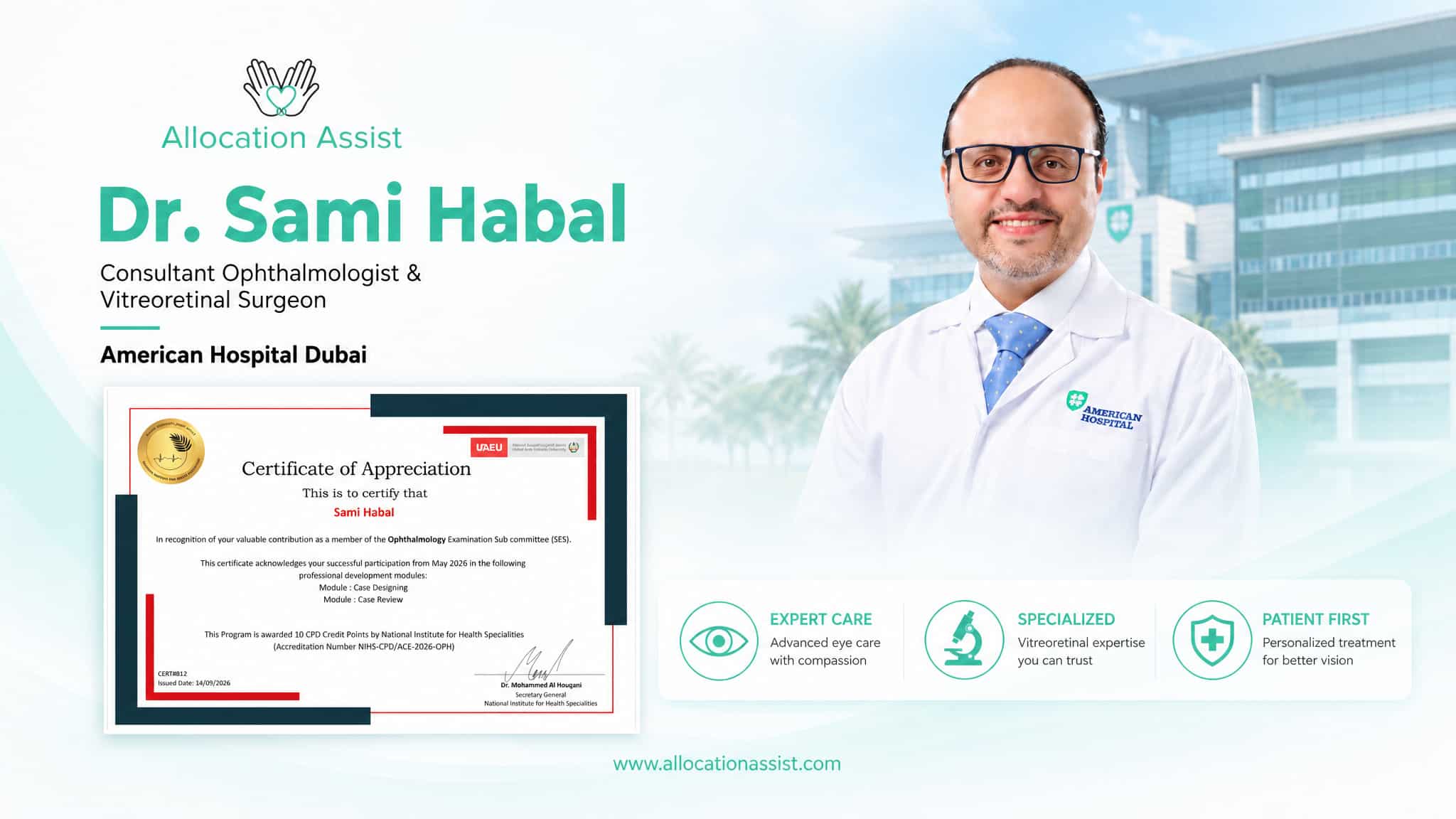
Many doctors wait for a new city to feel like home before they try to make their mark on it. Dr. Sami Habal took the other route. The Consultant Ophthalmologist and Vitreoretinal Surgeon at American Hospital Dubai has received a Certificate of Appreciation from the National Institute for Health Specialties in the UAE, a sign that his UK experience is already being felt in the country’s eye care community.
Key Takeaways
- Dr. Sami Habal is a Consultant Ophthalmologist and Vitreoretinal Surgeon at American Hospital Dubai.
- He has received a Certificate of Appreciation from the National Institute for Health Specialties in the UAE.
- Before moving to the UAE, he built extensive experience across leading NHS hospitals, including King’s College Hospital.
- His background spans complex retinal surgery and medical retina, alongside training future ophthalmologists.
- Allocation Assist Middle East is proud to have represented Dr. Habal in his move to Dubai.
Who Is Dr. Sami Habal?
Dr. Habal is a Consultant Ophthalmologist and Vitreoretinal Surgeon at American Hospital Dubai. Before moving to the UAE, he built extensive experience across leading NHS hospitals in the UK, including King’s College Hospital. He has also shared his advice for UK doctors weighing a move to Dubai.
His background spans complex retinal surgery and medical retina, two areas at the more demanding end of ophthalmology. Alongside his clinical work, he has been involved in training future ophthalmologists, and that teaching experience now travels with him to Dubai.
What Recognition Did He Receive in the UAE?
He was awarded a Certificate of Appreciation by the National Institute for Health Specialties in the UAE. For a consultant who relocated to the country, acknowledgement from a national body shows that his contribution reaches past the patients he sees in clinic.
The Allocation Assist Middle East team, who represented him in his move, shared the news with pride. Seeing a surgeon’s NHS experience feed into the UAE’s ophthalmology community, and being recognized along the way, is one of the most rewarding parts of their work.
How Does a Teaching Background Carry Over to a New Health System?
Training the next generation of eye surgeons was part of his work in the UK. That habit of passing knowledge on moves with the surgeon. A doctor who has taught retinal techniques brings more than his own case list to a new department; he brings a way of lifting the people around him.
Allocation Assist has watched hundreds of doctors relocate over the years, and one pattern stands out. The most accomplished doctors arrive wanting to contribute, to share what they know and to make a difference for patients and colleagues. They find their place through the impact they make rather than waiting until everything feels familiar.
What Should Western-Trained Ophthalmologists Know Before Moving to Dubai?
Doctors joining a private facility in Dubai, such as American Hospital Dubai, are licensed by the Dubai Health Authority. Getting the DHA licence right, with documents verified and the correct grade assigned, is usually the first practical step of any move.
Beyond paperwork, it pays to think about where your subspecialty fits. Dr. Habal’s experience shows that vitreoretinal surgeons with strong UK training and a teaching background can contribute to the wider specialty in the UAE as well as to their own department.
Conclusion
Dr. Sami Habal did not wait for Dubai to feel familiar before making his mark. With NHS experience that includes King’s College Hospital, expertise in complex retinal surgery and medical retina, and a track record of training future ophthalmologists, he has already been recognized by the National Institute for Health Specialties in the UAE. We are proud to see his contribution to the country’s eye care community grow.
Thinking About a Move to the Gulf?
Congratulations, Dr. Sami Habal. The Allocation Assist Middle East team is proud to have represented you in your move to Dubai and to see your work recognized so soon. Allocation Assist is a medical jobs consultancy in Dubai that handles doctor placement with leading hospitals across the UAE, Saudi Arabia and Qatar, drawing on more than 11 years of experience and a network of 95+ institutions. Ophthalmologists weighing a move can contact us or call +971 4 273 3477.
Frequently Asked Questions
Can UK-trained ophthalmologists work in Dubai?
Yes. UK-trained eye specialists can practise in Dubai once they hold a Dubai Health Authority licence, which is how Dr. Habal joined American Hospital Dubai.
How long does it take to get a DHA licence?
For doctors trained in recognised countries, the full process usually takes around three months. Primary source verification through DataFlow accounts for roughly four to eight weeks of that.
What documents do doctors need for a DHA licence?
You need your medical degree and transcripts, a current licence from your last country of practice, a certificate of good standing issued within the last six months, a passport copy and a photo. Surgeons also need a two-year logbook signed by a medical director.
Are doctor salaries in Dubai tax free?
Yes. Salaries in the UAE are tax free and negotiated individually. Western-trained consultants can earn a basic AED 80,000 to 90,000 a month, often with housing, schooling and flight allowances on top.
Can I get a DHA licence before I have a job offer?
Yes. You can complete registration first, and it becomes a full licence once a hospital sponsors you. Running licensing and doctor placement together means you can start soon after accepting an offer.
Which licence do doctors need outside Dubai?
Abu Dhabi, Al Ain and Al Dhafra require a DOH licence, while Sharjah and the northern emirates use MOHAP. Saudi Arabia licenses doctors through the SCFHS and Qatar through the QCHP.