If you’re a Singapore-trained specialist weighing a move to Dubai, the headline difference is take-home pay: with no personal income tax in the UAE, you keep more of what you earn, and that gap widens over a multi-year posting. Dubai also offers a 10-year Golden Visa that isn’t tied to your employer, larger family-friendly communities, and rising demand across newer medical fields. Singapore, for its part, still leads on training pipelines and medical-tourism rankings. The comparison below sets out where each city comes out ahead.
Dubai vs Singapore: What Doctors Should Compare First

On paper the gross salaries look close, with specialists in both cities earning roughly $177,000 to $278,000 a year. The divergence comes after tax. Singapore applies progressive resident rates that reach 24 percent on higher chargeable income, while the UAE levies nothing on employment earnings, so the same gross figure translates into a higher net in the UAE at every level.
Packages tend to differ too. Dubai offers commonly bundle relocation support, schooling contributions, and family health cover that Singapore employers rarely include. Clinical demand is the other factor: a widely cited Lancet estimate of a global shortfall of millions of doctors keeps experienced specialists in strong negotiating positions in hubs like the UAE. One caveat worth correcting up front, though: because Singapore is not on the DHA’s exam-exemption list, your licensing route is not a shortcut. You’ll sit the Prometric exam, and a realistic timeline is closer to four to six months than the three often quoted for exempt nationalities.
Take-Home Pay: Why the Net Figure Favours Dubai
The financial case rests on one mechanism. UAE salaries aren’t subject to personal income tax, so a doctor’s gross is effectively their net, whereas peers in Australia, the UK, or Canada lose 30 to 45 percent of comparable gross pay to their tax authorities. Stack a Dubai specialist’s net against what a similarly qualified doctor keeps in London or Sydney and the difference accumulates quickly over a five-year stretch, which is what lets relocating physicians reach savings targets faster than is realistic in a high-tax system.
The Tax Advantage in Practice
With no withholding, no annual filing, and no progressive brackets, your salary, bonus, and housing allowance arrive intact. Set that against Singapore’s rates of up to 24 percent for high earners: a specialist on AED 50,000 a month in Dubai keeps the full amount, while the Singapore-based equivalent hands a meaningful share to IRAS first.
The UAE also has no capital gains or inheritance tax, which extends the benefit beyond salary into longer-term wealth planning. To secure resident status for tax purposes, you’ll generally need to spend at least 183 days in the UAE within a 12-month period and obtain a Tax Residency Certificate from the Federal Tax Authority.
Net Salary Comparison
A zero-tax structure only helps if the base salary holds up, and for specialists it does.
| Destination | Gross Annual (USD) | Estimated Net (USD) |
|---|---|---|
| Dubai (senior specialist) | ~$178,500 | ~$178,500 |
| Australia (specialist) | ~$247,000 | ~$140,000, 170,000 |
| Canada (specialist) | ~$161,000 | ~$95,000, 110,000 |
Dubai’s gross sits below Australia’s, yet the net matches or exceeds it; against Canada the gap is wider still. Add untaxed housing and transport allowances, which can lift effective value by 20 to 30 percent, and the total package becomes hard to match in any taxed jurisdiction.
Faster Savings Growth
In practice, a mid-career physician netting AED 500,000 to 700,000 a year holds purchasing power close to a $300,000 gross salary elsewhere, without earning that headline number. Higher retained income plus a lower cost base is what accelerates saving, though the exact figure depends on your specialty, household, and lifestyle.
How Dubai’s Hospitals Compare to Singapore for Your Career
Singapore ranks at the top of the Medical Tourism Index for facilities and services, with Dubai sitting around sixth globally. The rankings, though, only tell part of the story. Singapore doctors adjusting to Dubai life is an interesting phenomenon as these professionals navigate a different healthcare landscape. Expat life for Singapore doctors can present unique challenges and opportunities as they acclimate to new medical practices and systems.
Dubai’s hospitals offer modern infrastructure, hotel-style patient rooms, and high-touch service, and you’ll work alongside colleagues trained in the US, UK, and EU within a familiar clinical culture. Where Singapore stays ahead is staffing depth, research output, and established training pipelines. Local hospitals run leaner on residents and trainees, which means less teaching structure but often more clinical autonomy, a trade-off whose value depends on your career stage. Singapore medical professionals relocating to Dubai will find many opportunities to advance their careers in the thriving healthcare sector.
Dubai’s Golden Visa vs Singapore’s Employment Pass
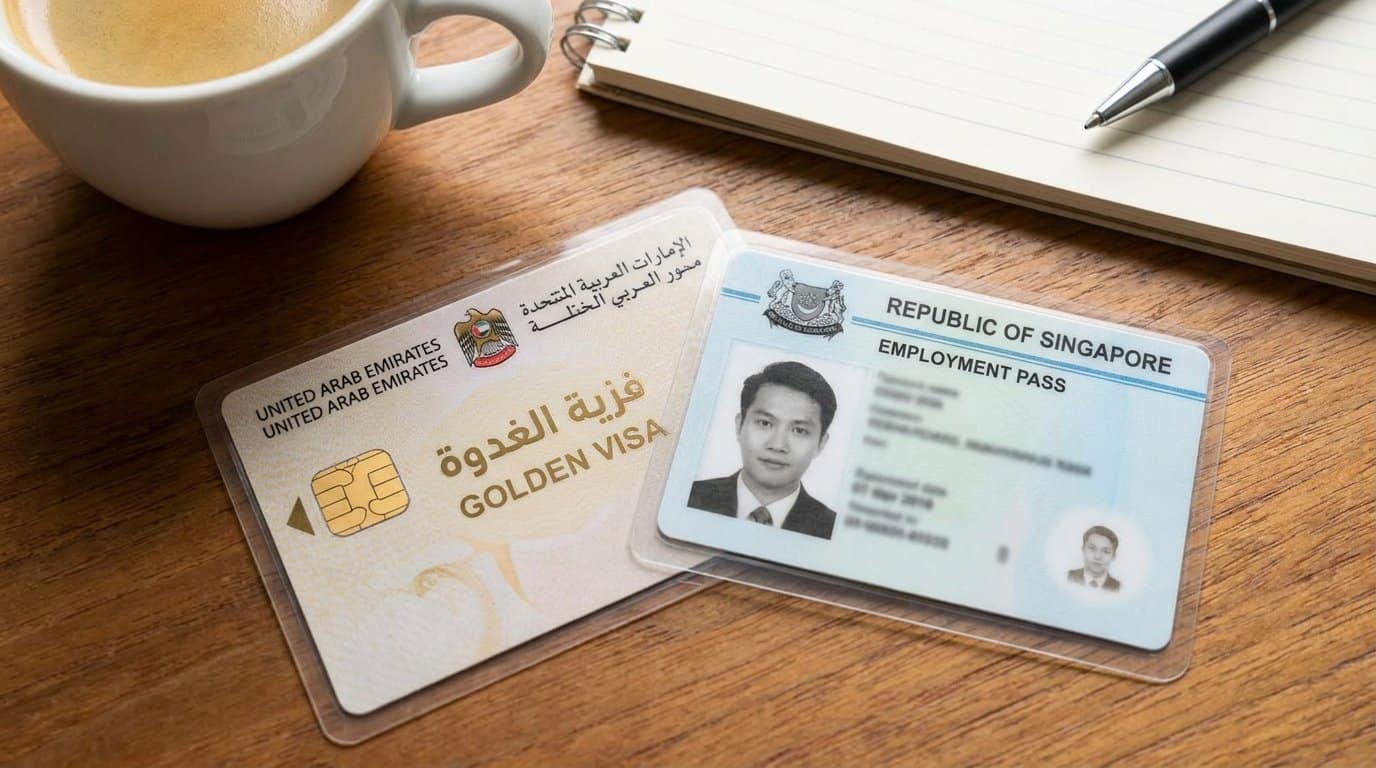
After salary and clinical scope, immigration status is the sharpest point of contrast. Singapore’s Employment Pass ties you to your employer, needs renewal every one to three years, and limits side ventures. The UAE Golden Visa changes that footing:
- Ten-year residency that isn’t dependent on a single sponsor.
- More flexibility on extended absences than Singapore’s shorter limits allow.
- Property ownership and the right to establish a business.
- Family sponsorship covering spouse, children, and parents.
- No personal income tax for the duration of your residency.
The practical comparison is between temporary, employer-linked permission and longer-term settlement designed to retain senior professionals.
Schools, Safety, and Family Life as an Expat Doctor
For most doctors with families, the decision isn’t only financial. It’s a judgment about where children will settle, whether a partner will feel at home, and how daily life works once the contract is signed.
Dubai’s international schools, including GEMS, Dubai American Academy, and Nord Anglia, run British, American, and IB curriculums at roughly AED 35,000 to 90,000 a year, giving families a range of options. On safety, the UAE consistently sits at or near the top of the Numbeo global index, scoring in the mid-80s and ranking above most established Western and Asian cities. Communities such as Arabian Ranches and Dubai Hills also offer more space than Singapore’s compact layout typically allows. Combined with untaxed income, beaches, and a population spanning more than 200 nationalities, the family-lifestyle case is a strong one.
Is Dubai or Singapore Better for Doctors Long-Term?

Over a 10- or 20-year horizon, the fundamentals divide like this:
- Tax efficiency: the UAE’s zero income tax versus Singapore’s progressive rates up to 24 percent compounds in your favour over time.
- Property access: Dubai’s freehold zones allow foreign ownership; Singapore restricts it more tightly.
- Residency: the Golden Visa gives ten years of stability without continuous employment.
- Healthcare growth: Dubai’s private hospital sector is expanding quickly, generating specialist demand that Singapore’s mature market produces less of.
- Diversification: Dubai’s wider economic growth opens secondary income options.
Singapore offers stability and a deeper academic system; Dubai offers a stronger financial trajectory and faster-growing demand. Which matters more depends on what you want the next two decades to look like.
Looking to Build a New Life in the Middle East?
Being a doctor in Dubai brings a standard of living that many can only dream of. Allocation Assist has been placing internationally trained doctors in Dubai and across the Gulf for over a decade, matching each doctor with a role that fits. To explore your options, book a free consultation and the team will take it from there.
Frequently Asked Questions
How Does Dubai’s Licensing Compare to Australia’s for Singapore Doctors?
Dubai’s route is generally quicker. DHA registration commonly runs about four to six months and centres on DataFlow verification plus the Prometric exam. Australia’s AMC pathway often takes longer, with its own examinations, an English-proficiency requirement, and a period of supervised practice before full registration. Neither is a formality for a Singapore graduate, but Dubai’s timeline and tax-free pay make the overall package competitive.
Can Singapore Doctors Earn More in Dubai Than in the UK?
In most cases, yes. Dubai’s gross specialist range of roughly $177,000 to $270,000 already sits above typical UK levels, and the figure isn’t reduced by income tax. UK doctors face substantial deductions, so at equivalent seniority the net difference is sizeable.
Do Singapore Qualifications Transfer to Dubai Without Exams?
No. You’ll complete DataFlow credential verification, obtain a DHA eligibility letter, and pass a specialty-specific Prometric exam. Singapore is not on the DHA’s exemption list, so the exam applies regardless of grade, though processing is comparatively fast once your documents are in order.
How Does Dubai’s Medical-Tourism Growth Compare to Thailand and Malaysia?
Dubai is growing fast but still trails Thailand and Malaysia on patient volume. Its position is more about premium, high-end care than sheer numbers, backed by heavy government investment, with UAE health expenditure projected to reach about $30.7 billion by 2027. For specialists, that points to higher-value cases rather than the largest patient counts.
What’s the First Step if I Want to Move?
Start DataFlow verification of your SMC registration and your NUS, NTU, or Duke-NUS qualifications, since it gates everything else. You can begin while still working in Singapore, and a job offer is only needed later at license activation. Arrange any Mandarin or Malay translations early to avoid a hold mid-process.